Govt raises wheat prices as farmers blighted by rust and climate
3 min read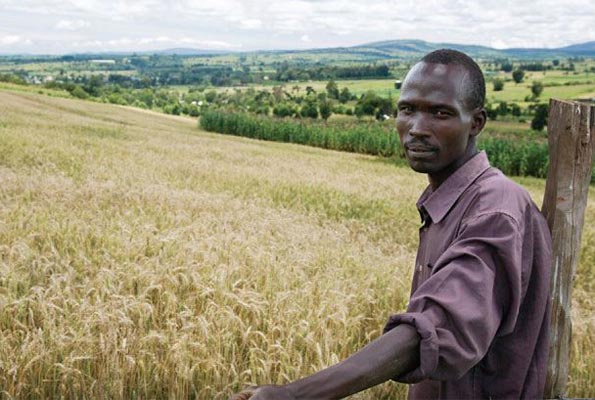
By Antynet Ford
The Ministry of Agriculture has increased wheat payments by 7 per cent, up from Sh4750 to Sh5100 per 90Kg bag, at its aggregation centres, in a drive to draw in more wheat, following. 40 per cent drop in the current harvest.
Making the announcement, Agriculture Cabinet Secretary Mutahi Kagwe said the new prices were arrived at after consultations with wheat growers coordinated by the Agriculture and Food Authority (AFA) and the Cereal Growers Association (CGA) and millers.
According to the ministry, more than 2,000 wheat farmers from Narok, Nakuru, Meru, Laikipia, Nyandarua and Uasin Gishu counties are expected to benefit from the improved producer price, with the government expecting about 1.0 million 90-kilogram bags of wheat to be harvested during the 2026 season, compared with approximately 1.7 million bags produced last year, as stem and yellow rust have slashed yields across Kenya by almost 50 per cent.
The government banned the main pesticide used for the diseases in 2023, leaving only one in place that has been widely shown to develop resistance if used for two consecutive seasons. With that backup exhausted, farmers have suffered a surge in crop losses on the now uncontrolled disease.
Some farmers have switched to barley, which is less prone to the two rusts, and which was earning around Sh5,300 per bag last season. Barley prices have since dropped to between Sh4,200 and Sh4,500 per bag, making wheat production more competitive again at the new price.
The government said it was also implementing other measures to increase wheat production and reduce Kenya’s reliance on imports, including expanding fertiliser subsidies, promoting high-yielding and climate-resilient varieties, increasing mechanization and supporting commercial wheat farming.
It has not announced a new solution to wheat rust, as yet. But the government is hoping for some recovery in the short season ahead, taking wheat production up by 5 per cent.
“The government remains committed to revitalising the country’s wheat industry and reducing dependence on imports through targeted interventions aimed at increasing productivity and lowering production costs,” said Kagwe.
Compared to the western Europe, where a hectare of wheat produces an average of 7.2 tonnes, Kenya only produces 2 to 2.5 tonnes per hectare with wheat rust being its biggest menace. Wheat farmer Erick Kigen shared in a FarmbizAfrica interviews that he harvested just 16 bags of 90 Kg per acre when his wheat field was attacked by rust.
Wheat rust affects almost half of wheat fields in Kenya, which was where the now global disease first appeared. A 2023 study by CIMMYT of 132 wheat fields in the north and central Rift found 102 with rust infections, of which 60 were stem rust and 42 were yellow rust.
According to the study, the amount of rainfall makes a difference to the severity, with Erick confirming that the disease becomes steadily harder to control during cold and rainy periods when the fungal diseases spread faster.
In 2026, heavy rainfall from February to April saw wheat planted into notably wet soils and conditions, although it also saw some wheat farmers delay planting, only to then suffer from insufficient subsequent rain.