
Blight wipes out Kenya’s potatoes after banning of pest controls
By Jael Maunda
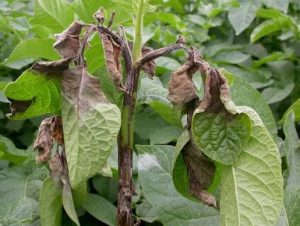
Potato farmers are reporting complete crop destruction in Kenya from blight, the disease that killed a million people in the Irish potato famine, after the banning of all its viable disease controls by the Kenyan government.
Michael Waweru, a potato farmer from Nyandarua County, reported that he had lost over Sh3m to the disease this year.
“I lost a huge amount of money, I had planted 47 acres of satisfying potatoes, I had followed all the right agricultural practices. What I harvested did not give me even Sh400,000. Blight affected my crop such that I could not recover the seed that I had planted. The crops were affected to the extent that even if we applied the curated fungicides, they did not work,” he said.
The crop wipeout has doubled potato prices and now threatens a staple foods crisis, with potatoes the main staple food in Central Province, and the country’s second largest staple after maize.
National media and government have cited the weather as the cause. But, say farmers, the weather made the blight worse from March, as a disease that increases with rain and higher temperatures, but the losses were directly caused by the loss of blight controls, which made the disease so severe they no longer have enough seed potatoes left to plant for the next season.
‘In 2025/2026, potato blight has really increased.” said Michael. “This year, around March, we witnessed heavy rainfall and, because of waterlogging, really affected me. My potatoes were at a flowering stage despite applying all types of fungicides, it did not work.”
The cheap preventative for potato blight was chlorothalonil, banned by the government in 2023/2024, and the Pest Control Products Board (PCPB) within the Ministry of Agriculture has since also banned the main, and really only viable, treatment, Mancozeb.
Looking back, Michael said, “in 2023/24, we could predict seasons that crops might be affected by blight and we could spray fungicides. Right now, it has become unpredictable and uncontrollable. Sometimes, even if you apply the fungicides, it does not work.“
Over his years of farming, said Michael, “I applied fungicides every 14 days. If the crop was already affected, I applied curative and protective fungicides, which are very costly at the same time. When the crop was not affected, we only applied protective fungicides which were cheap.”
‘Comparing the years, I learned from fellow farmers how to protect potatoes from blight. initially. I would wait until the crop was affected by blight. That is when I would spray the fungicides. I later learned that blight is fungal and water logging on the farm largely led to blight.”
“Right now, I make sure that there is proper drainage in the farm.”
“Also, I consistently spray my crops with both curative and protective fungicides. Right now, even if the crop is not affected, I spray it to protect it. I start applying fungicides immediately after 3 weeks of germination. If we note that the crop has already been affected by the blight by coiling the leaves and black spots that appear at the tip of the crop, we start applying curative fungicides,” he said.
But the fungicides are no longer working, he said.
Traditionally, he used Mancozeb-based brands, which are now banned, and the government has offered no advice or route to replacements, or food.
‘We used Ridomil Gold, Mistress and Zetanil. These we applied when the crop was not affected for protective purposes. If the crop was already affected, we usually used Infinito, which is very expensive. In a season when the crops were not affected, we spent Sh700 per acre when applying, for example, Redomil Gold. If it was affected, we used Infinito fungicide in the past years. It would cost Sh2200 and when buying it wholesale, we could buy it at Sh1900, but currently it is around Sh2800 to Sh3000, which is used per acre.”
The government has never published, and is not known to have conducted, any impact assessment of the food security consequences of its pest control bans, nor has it ever published any statement on how farmers can now control late blight with these controls removed, but, globally, there are no known alternatives that are not prone to resistance when used to prevent or treat blight.
The result has been an increase in pesticide use by farmers as they try to tackle the problems with the frequent use of less effective, single-site pesticides in efforts to control the disease.
“Around June this year we did not have rain, but we had a lot of blight ..It was not because of excess rains or waterlogging, it was just a blight that came from nowhere and affected most of the crops. Based on these changes, we were forced to apply fungicides every 7 days when it is extremely cold and 14 days when there is average rainfall.”
Yet, even with sharp increases, as a doubling or more, of pesticide use, farmers have been unable to save their potato crops.
Free members’ zone
Get your farming news by email.
Free. Market prices, crop news and farmer opportunities, straight to your inbox.