
Cocoa type dictates prices and markets for new growers, say experts
By Marion Achieng
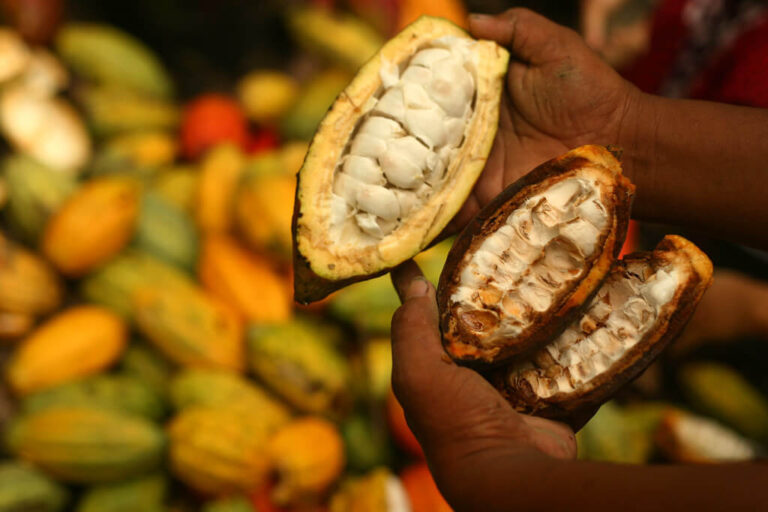
As Kenya now moves into cocoa, the seedlings farmers choose will define their market for 30 years ahead, with some built for bulk markets, and some for specialist premium sales, according to industry experts.
In Kenya, the testing by the Kenya Agricultural and Livestock Research Organization (KALRO) in Mtwapa ruled out one of the three main types of cocoa as producing poorly locally.
Speaking to FarmBizAfrica, Lucky Tunje of KALRO Mtwapa said in trials at the centre, two leading varieties Criollo and Forastero did well, while a third, Trinitario, failed.
Of these, Forastero is the main cocoa grown globally, accounting for 80 to 90 per cent of global sales and used mainly in milk chocolate or as a base for cocoa flavouring.
In Uganda, where cocoa growing is now established, farmers are almost exclusively growing Forastero, which is easier to sell than Criollo and does not require any special processing.
The Forastero cocoa variety is also ideal for Kenyan farmers interested in mass production, said Lucky, because it is more resistant to pests and disease than Criollo, so farmers spend less money on pest control.
“Forastero is resilient against pest and diseases, so it is very easy to grow in terms of management cost compared to Criollo,” he said.
Criollo’s greater scent attracts destructive pests that can damage the leaves of the cocoa plant, preventing the trees from forming proper shade, affecting healthy growth, and causing a reduction in yields, he said.
“Criollo is sweet, pests love it. It has a sweet, floral scent so pests are attracted to that smell, to this variety. So you get that pests eat its leaves more compared to Forastero.”
“Most of the commercial producers of cocoa products, if they have their own farms, they prefer Forastero over Criollo because they want to keep production costs low.”
He said Forastero also produces bigger pods than Criollo and these pods have more beans, so farmers get more yields in the end.
“The bigger the pod, the more the beans. Criollo pods are slightly smaller so they have less beans.”
However, Criollo wins in the sweetness and aroma category. Its beans are sweet and have a rich aroma, making it suitable for those looking for flavourful cocoa. It also fetches higher prices.
“Criollo beans may be smaller than Forastero’s but they are a good choice if the target market wants aroma. Rich people… love scents. Even if it is an edible product, they want it to have a nice smell. They would rather buy it, even if it is expensive, but meet their lifestyle. But for some of us, once we eat chocolate our day is made, strong aromas may not matter that much,” said Lucky.
Globally, Criollo fetches prices from 20 to 300 per cent higher than Forastero, but this depends on quality, and requires local buying and processing that is not readily available in Kenya.
The planned processing in Kenya by Chambers Federation will buy all types of cocoa with Chambers already equipped to process Criolla, and able to pay more for the bean where it has not been exposed to crossbreeding.
But manufacturers most often mask Forastero beans’ more bitter taste with additives.
“Criollo is sweet…You do not have to add as many ingredients because it has its own sweetness. Forastero isn’t that sweet but manufacturers can add other ingredients to balance the taste so they end up with a mixture as sweet as Criollo.”
“That is why manufacturers prefer Forastero. They would rather add a kilogramme of sugar in that mixture instead of half a kilogramme to less beans. It is a matter of balancing and it works.”
For farmers, the gains in yield and pest resistance can also more than offset the lower price per kilogramme for Forastero.
Yield data is thin globally and can vary a lot, but average yields of Forastero in West Africa sit fairly tightly around 375 kg per acre, although they can run as high as 3000 kg or more. By contrast, specialist Criollo growers report growing half this average volume.
“In reality, cross pollination between the varieties is quite common so even on the same tree you can see different types of pods grow. This is where we start to detail the three well-known varieties into over 26 varieties … Forastero is the general description given to the most robust grouping of varieties,” said Matthew Chambers of Chambers Federation, which is giving Kenyan cocoa farmers buying contracts even ahead of planting.
“We buy and process all three varieties,” he said. “If a farmer only grew Criollo or only Trinitario, where there’s no risk of cross pollination, and they have over 100kgs of wet beans that we can ferment together, then yes, we would pay more, conditionally.”
“The processing equipment is the same, just different fermentation and drying protocols (timings) are required,” he said.
Trinitario is a hybrid of Criollo and Forastero and combines Criollo’s rich aroma and Forastero’s disease resistance, so it can be a strong option for farmers seeking higher yields and improved prices. And while KALRO Mtwapa is not growing the Trinitario seedlings at the coast, there are farmers who grow it in Kenya and “it does well”, said Lucky.
Farmers in Kenya can get Criollo and Forastero cocoa seedlings from the KALRO centre in Mtwapa, which delivers countrywide. They can also pick up their orders from KALRO Msabaha and Matuga.
Get your farming news by email.
Free. Market prices, crop news and farmer opportunities, straight to your inbox.