
Couple create mass of free food with path-side community farming
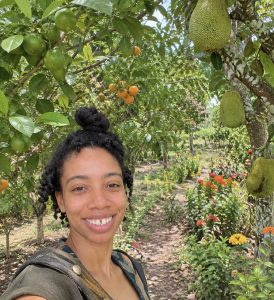
By Antynet Ford
Paying may just be what is leaving the world short of food, according to one globe trotting couple with an app and a mission, who are spawning a community farming movement in Brazil by planting up side walks with crops that anyone can take food from and anyone can help tend and grow, all for free.
The Trott Bailey family in Prado Bahia area of Brazil has been giving out seeds and sidewalk harvests to neighbours, passersby, and tourists, who are increasingly engaging in the hot work of planting and tending the community crops, said Trott, the father of the family.
Speaking to FarmbizAfrica, he said while they started the project as an experiment on growing crops in the hot sandy soil, within a year they were sharing an average of around 27 kg a day of produce, across bananas, limes, papaya, flowers and seedlings, while the community and tourists were contributing growing volumes of seeds and donating their time to weed and help with the farming.
“Our abundance theory is what made us to start giving out the seedlings to neighbours and passersby,” he said. “Food needs to be abundant.”
“This is a tourist area and the giving of seedlings extends to the tourists visiting the area as well, when they are available. Apart from banana seedlings, we also give passersby lime seedlings, lime does very well here as well. We give also papaya seedlings and a variety of flowers,” he said.
To sustain and spread the project, they created an app available on their website, for people to donate time or seeds, or collect harvest-ready fruits across Brazil, and globally, in an initiative the Trott said is now producing more food than if they had been producing it for sale.
“Growing up, and for my wife especially, she had a lot of fruits and they didn’t have to buy mangoes as they were even present at the local schools which were very big. That’s how we are trying to pass on our childhood. We didn’t pay to eat and that’s why we are doing it, as not everything has to be accessible through the supermarket. We are just concerned about the future. It is from that, that we think abundance is required and things can be easily accessible,” he said.
“I know people think the economic part of it is that ‘how are you going to sustain a free model’? Or how are we going to sustain our project food, which is at the side of the road, or how are we going to sustain giving out to people passing by picking the fruits and eating? We created our family mobile app where people can donate things like peelings of banana etc (for the soil compost).”
“On the app, they can also donate seeds like watermelon seeds, pumpkin seeds and in exchange to what they donate, we give them seedlings, but we give the regular passersby seedlings too should we have any.”
To organise roadside community farming “the app is available to everyone world-wide on our website. It can be downloaded and it built for anyone who wants to run a sustainable project free,” said Trott. It has seen them invited all over the world to explain how the project works.
“It connects resources that people can exchange together and form that exchange of resources, for example, some people donate time. They come up pick up the grass, clear the weeds, clear the trash or water the flowers and in exchange when they donate their time they can do some harvesting of strawberries or pick some other fruits,” he said.
“I had a notion that people can’t do that when we started it because we were thinking they’ll just come take what we are giving out and not help around. They might never feel it is a lot of work. When we started the project no one really participated because we did not invite them to participate …they were interested but did not know how to come and say, ‘hey we want to help around.’” he said.
So they started looking for ways of exchanging. “For example, we needed the banana plants and we put up signage that people could do this at home. It is more inviting and educational and out of that curiosity someone realised that I can contribute in this regard and I can a get a fruit to take home…it was a misconception from our part that nobody was going to come and farm with us while the sun is hot etc.”.
“We did our project for free, but we have returns and have benefited a lot in a different way other than selling the crops. The knowledge is powerful. We have earned in a different capacity other than money. Look at me now, I am speaking to you in Kenya because of this farming that we are doing here. It is not about thinking I would have sold the produce and got more money, it is one’s impact over time,” he said.
The family has also had farming breakthroughs from the work, learning, for instance, how to produce 30-40 banana suckers at a time.
“With this, we learnt a model to propagate bananas and plantains. With that method it takes us about six weeks. We take a banana sucker, probably about six to nine months old, we cut the stem off, clear the root area until it’s a small side that can be held on the hand and it is all white after we have cleared all the other parts. We then place it in ash. After we place it in ash, we leave it in sawdust in a well germinated soil and in a cool area for three weeks,” he said.
“That one sucker in our experience produces about 30-40 different suckers, a very small stem full of life.”
“We learnt it by accident. We lost our banana and we chopped it, put it aside as mulch for another banana plant, but in a few weeks we realised it had suckers. From there, we realized we can multiply banana rapidly and with this notion, we are testing banana and food being free,” he said.
The Trott Bailey app is on their website at https://trottbaileyfamily.com/
Read next
Get your farming news by email.
Free. Market prices, crop news and farmer opportunities, straight to your inbox.
Set county, crops and alerts
Become a free member so weather and saved tools follow your farm profile