
Duck lady Sarah finds egg and bird business in Kenya
By MaryAnne Musilo
Serah Wanzau got into the duck business through a few try-it-and-see social media posts, but found a string market, even turning away a supermarket contract for the eggs because she couldn’t meet the volume of demand.
“I have been having ducks for years, but started seeing it as a business five years ago. I started posting my birds online on Instagram, Facebook and TikTok, and clients started calling and inquiring. This is when I got to know there is a market,” she said.
Sarah has almost always had ducks, following her mother, who used to rear them for the family to eat, and rearing them in Kinoo, before now moving to Machakos.
“In my farm we sell fertilised eggs and table eggs (eggs that are not fertilised). Both are very marketable. For fertilised eggs, I sell fresh eggs that are between one and five days old because I am sure they will hatch. I would not sell eggs that I am not sure of because it is unethical. I want someone to buy from me and benefit from me. For table eggs, I sell the ones that are between five and seven days old,” she said.
But she hasn’t been able to keep up with demand.
“You cannot find a section for duck meat and eggs in the supermarket. This is the problem I saw and it gave me the drive to get into this kind of business. Actually, there is a supermarket that reached out to me and wanted me to supply eggs, but I ended up not taking the contract because I could not meet their demand,” she said.
“After getting that proposal from the supermarket, I tried getting other duck farmers that I could buy eggs from to supply, but getting a lot of eggs was an issue. The client wanted about 500 eggs per week. This became a challenge because the farmers I got also had other clients to satisfy and maintain.”
Serah later got an order of 2,000 ducks per month from another supermarket. They wanted to sell them for meat.
“I got a farmer in Uganda who was willing to supply 1,500 ducks per month, but after doing all the calculations, including logistics, I was going to make a loss or no profit at all. I had to cancel the contract,” she said.
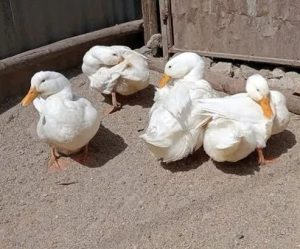
She has several varieties of ducks, Muscovy, Cayuga, Rouen, Khaki Campbell, Pekin and also now keeps geese.
“For Muscovy and Pekin I sell at Sh170 per egg, while for Cayuga, Rouen and Khaki Campbell, since they are ornamental birds, I sell eggs at Sh200. I do not sell goose eggs because I want to have many of them,” she said.
Altogether, she sells about seven trays of eggs per month.
“I have never sat down to count how many eggs I sell because we also consume some here at home. But I have one loyal client who buys three trays of table eggs per month, making between Sh15,300 and Sh18,000 from a single client.”
“I deliver a minimum of 20 eggs when a buyer requests. This is because there are transport charges. When someone buys four or five eggs, the transport fare becomes too much, because my clients are the ones who pay for transport. So when buying fewer than 20 eggs, the buyer has to come to the farm.”.
She does also sell mature ducks.
“We do not sell meat. We sell mature birds. This is because clients want different sizes of meat. For example, a client may want to buy one kilogram of meat and maybe the duck weighs 1.5kg or 1.8kg. Selling meat would be a disadvantage, so we just sell the whole bird,” she said.
“Right now the birds I have are for display. I have 16 birds. I just relocated from Kinoo to Machakos and my goal is to expand the farm. In Kinoo, I had around 80 birds, but we are still selling the birds,” she said.
“A mature Muscovy goes for Sh4,000, while a pair goes for Sh8,000. A Pekin goes for Sh3,000, while a pair goes for Sh6,000. A mature Khaki Campbell, goose and Rouen each go for Sh3,500, while a pair goes for Sh7,000,” she said.
Transporting the live birds can be a challenge.
“I once had a buyer from Dubai who wanted me to deliver 14 Khaki Campbells to his friend in Malindi. I had to send them as a parcel. He paid half of the price and the transport fee. The birds were to be transported at night because ducks get hot during the day when they do not have somewhere to swim. I soaked them in water and took them to the bus station in Nairobi. Thirteen birds made it to Malindi, but one died. I believe this was because there was a delay and the birds did not get to the coast in the anticipated time. But the buyer was very happy and paid the remaining amount,” she said.
Rearing the ducks requires multiple coops.
“I discourage crossbreeding because no one wants a crossbreed. If you start mixing Pekin and Muscovy, you will end up with a funny breed, and the crossbreeds do not procreate. In my coop I do not mix the birds. Every breed has its own coop, and that also helps me get pure eggs to sell to my clients,” she said.
In the coop, she said, it is important to put in sawdust or hay. Cleaning the coop is also very important. Ducks also love water, meaning they need a swimming pond.
“Ducks love mating in water. It is important to have a pond for them to swim and clean themselves. I clean the pool three times a week and, since they poop in the water, I use the water as manure on my farm,” she said.
There time in the water makes them hardier than other poultry. Their constant time in water washes away a lot of the external parasites such as mites, lice and fleas that plague chickens. They also have stronger respiratory systems and a natural resistance to many common poultry illnesses such as Marek’s disease and coccidiosis, but do need deworming.
“I once saw a video online of a farmer giving ducks chilli for deworming. Since I cannot trust everything online, I did my research and settled on mixing aloe vera and chilli with water and giving it to my birds. This improves immunity and acts as an antibiotic and dewormer,” she said.
She also now makes her own feeds.
“Maintaining the same feed variety was hard. I could go to an agrovet and buy Fugo feeds, then next time I find there is no Fugo and I am forced to buy Pembe. This is not good because ducks need to adapt to certain feeds to give good production, and different types of feeds have different ingredients,” she said.
So she attended an agricultural training centre, after seeing a post in her home area, and learned how to make the feeds.
“The training centre opens twice a year and sells the feed. I went late because I did not know when they opened. I just got sorghum, which was better than nothing. They were selling a kilo at Sh10. I bought around 800kg. I then learnt how to make my own feed. I buy maize germ, sorghum, protein, wheat bran, sunflower, ochong’a and mix in my own ratio. I just ensure they get a balanced diet, because this maintains good egg production,” she said.
Sarah also offers training in duck farming and farm tours, at Sh1,500 per person.
Get your farming news by email.
Free. Market prices, crop news and farmer opportunities, straight to your inbox.