
Entrepreneur develops ochong’a poultry feed to slash chicken deaths
By MaryAnne Musilo
Kenyan entrepreneur Harrison Maina is building high-protein feeds for poultry farmers by converting omena shrimps (ochong’a) into feeds to stop Kenya’s roughly 30m chicken deaths a year caused by low nutrition on poor feeds.
“I started by selling ochong’a, then the idea of making feeds came to me. This is because I would see farmers buy feeds at a very high cost and then later deal with mortality or stagnant growth. To curb this problem, I collaborated with two other people and we go to farms and get raw materials like soya beans, maize germ, shrimps, sunflower and many other things to make good quality feeds named Minimi Feeds,” he said.
“Also it was a good way to minimise prices. I sell the shrimps at Sh4,500 per 50kg bag and sell the feeds at a maximum of Sh2,500 of 50kg bag. Though some farmers still prefer to buy the shrimps.”
Feed prices have risen more rapidly in Kenya than in other African countries, up by around 45% since January 2025, 20 months ago, versus a rise of under 3% in countries such as Ghana. The cause of the steep climb, according to a Competition Authority of Kenya (CAK) inquiry, is the concentration of the industry across just four dominant importers, charging a hefty premium on raw materials that are also taxed heavily on import to Kenya, at 21% to 60%.
Minimi contracts fishermen and middlemen who supply them with the ochong’a and has worked with farmers to stimulate the local production of the soya, maize germ and sunflower that is imported by big producers.
Its heavier use of fish meal means the feed is no cheaper for farmers, at Sh2500 per 50kg bag compared with around Sh2,200 to Sh2500 for mainstream feeds. But the higher fishmeal content promotes faster growth and production in chicken due to ochong’a’s high levels of protein, calcium, amino acids, vitamins and minerals.
In many sectors, such as pig feed, it has been the protein that has driven prices up the most, with protein levels often pared back to save costs. In most mainstream feeds, fishmeal accounts for just over 2% of the content, and has also been in increasingly short supply, according to researchers, meaning Harrison’s work to set up local supplies is delivering higher health at equivalent prices.
With researchers reporting that some 60% of chickens die before sale or consumption, with poor nutrition the leading cause, this protein bonus is a real competitive advantage, said Harrison, in an interview with FarmBizAfrica..
“They (ochang’a) can be mixed with livestock feeds and can be also fed to pigs, fish, dogs and cats. We are now transitioning in making all animal feeds but have already started on the fish meal,” he said.
“For quality assurance and quality control, we ensure all the ochong’a is dried and the moisture content is correct. When we started others knew how to dry them, but others, we had to train them. There was a time it was rainy and they used to store it in buckets and I bought it too soon before it dried and it had started to go bad. This makes its quality go down and making feeds from it was not okay. We had to dry it again and sell it at a loss. I took it upon myself to teach them on how to dry the shrimps.”
“We prefer when the moisture percentage is less than 13%, not more, because we use it to make feeds, where not getting the correct moisture makes us not have good quality feeds,”
But that means engaging right at source.
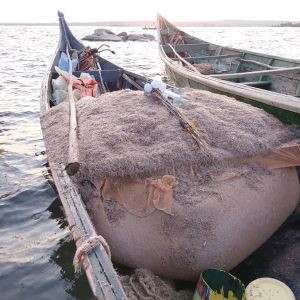
“They (ochang’a) are most harvested at night. When the fishermen are fishing and have their lights on, the shrimps are attracted to light and then when the net is pulled they are also fished. The fishermen then sell the omena and fish for human consumption and the shrimps for livestock. Mostly, the middle men/brokers buy from them when it is watery. They then dry it in the sun for one or two days. Then we buy it for value addition. We buy at a minimum of Sh50 per kilo,” he said.
“Sometime back fishermen used to sell the ochong’a using kasuku’s and basins, but we introduced the standard way, where we buy per kilo. Prices fluctuate according to supply. At times there is an oversupply, where prices will go down and when the supply is low, the price goes up. Though they normally range between Sh50 to Sh80.”
But the market is vibrant.
“Market is there because people are now embracing agriculture and feeds are important in agriculture. I have a client in Uganda who buy feeds and, at times, the raw materials, that is the shrimps. He is a duck farmer. He pays for transport and we get the goods to the border. He buys 200 kg of the shrimps every month,” he said
“People come from Congo, Porto Rico to see what we do at Minimi,”
Before he started making the feeds, he first scouted and registered farmers who wanted to buy, to solve the market issue first. He then started making the feeds and providing services, after knowing what his clients expected and needed.
“We also have veterinary services named Minimi Veterinary Services, where we are to launch a mobile app/ service soon that farmers can subscribe and talk directly to a vet. We also provide farm managing services. Through this, we are sure all materials we get are of good quality because we manage most farms we buy products from,” he said.
Get your farming news by email.
Free. Market prices, crop news and farmer opportunities, straight to your inbox.