
Gilgil farmer gets plentiful vegetables with ash-recycled wastewater
By Antynet Ford
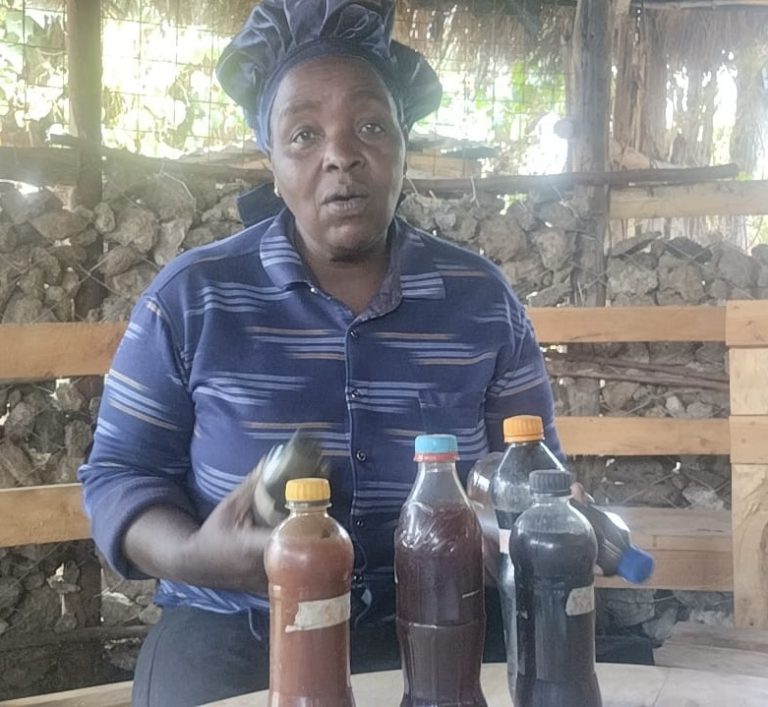
Beatrice Wangui, capturing rain water for her home use in Gilgil, is recycling her washing water using wood ash and charcoal to irrigate successful arrowroot, indigenous vegetables, and maize plots that are feeding her family and generating an income.
In an interview on her farm with FarmBizAfrica, Beatrice said the recycling had ended any need for her to go to the market for vegetables and was also earning her over Sh8,500 a month in additional sales.
“When I wash clothes, I do not dispose of the water. You see, with water being a big challenge in Langalanga, I have to ensure that no amount of water goes into wastage. So I recycle the water into my farm after I purify it with wood ash. When you place wood ash into the water, it clears all the chemicals from soap in the water and it is clean for irrigating the crops at the farm,” said Beatrice said.
“I do the same for kitchen waste water that I use to clean utensils and other kitchen services. As you can see, the kitchen waste water is redirected to where the arrowroots are grown and they are doing well,” she said.
“For vegetables, I sell to a company who buy a kilo for Sh25 and it is a readily available market with no middlemen. I do rotational farming for Sukuma wiki and spinach on 35 Vetagro paper towers I have made. The indigenous vegetables take a little more space that is why I have set them aside after making good soil separately and flat on the side of the farm,” she said.
“I make my harvest after every 14 days and on a good day, I harvest up to 120 kg of spinach, which is about Sh6,000 a month. For the indigenous vegetables, I make about 100 kg and the pricing is still the same Sh25 per kilo. This is money I did not know I could make because of the rocks and I did not know about the recycling of water in the farm,” she said.
Beatrice said the mix of harvested and recycled water was giving her enough to irrigate her arrowroot and indigenous vegetables twice a week all year round, which she combines with mulch to keep moisture in the soil.
To recycle the water, she adds a small handful of wood ash to about 20 litres of soapy water, stirs it well, and leaves it to stand for a few hours. The dirt and soap settle, leaving the cleaned water at the top, which she irrigates the arrowroot with.
For the indigenous vegetables, Beatrice filters the water a second time through sand, gravel and soil in layers in the bottom of a bucket, with a hole at the bottom covered with cloth to keep the sand in, but let the water through.
She uses the double-filtered water to grow terere, saga and managu, as well as spinach and the normal and matumbo sukuma wiki, which she sells to neighbours, making extra income. She also grows indigenous maize varieties, yellow, purple and red, which she sells as food and seeds which she sells at Sh200 per kg.
Growing these crops, she said, has meant she has not had to go to the market to buy vegetables for the last three years.
“Before the harvesting of rain water, recycling waste water and having vertical gardens, I was working on people’s farms in order to get food for my family. I always knew that nothing would grow in the rocks.But this farming is able to feed my family and also earn a living from it, as I sell the maize, vegetables and seeds, making a good fortune from it,” she said.
Research by James Fowler published by Practical Off-grid Living in March 2024 found that farmers could increase production by using wood ash as a natural filter for irrigation water. But the ash can leave residual lime and potassium carbonate making it alkaline. The process works well, but farmers need to check the water is not too alkaline.
An excessively alkaline environment can cause damage to the leaves and stems of plants, while also disrupting the delicate balance of aquatic ecosystems. To mitigate these risks, it is essential to test the pH level of the wood ash before applying it as a filtration agent,” reported James. “Wood ash can have a high pH level typically ranging between 8 and 10, which can be detrimental”
Get your farming news by email.
Free. Market prices, crop news and farmer opportunities, straight to your inbox.