
Kajiado farmer switches from dairy cows to camels to beat rising feed costs
By Antynet Ford
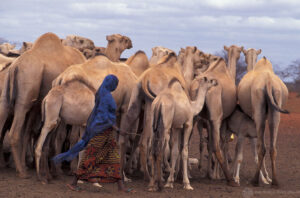
Kajiado dairy farmer, Ole Nkiu Lele has opted to keep his 30 head of camel for milk, over dairy cattle, to evade the huge feeds costs of the recent years by switching to the low feeders.
Speaking to FarmBizAfrica, Nkiu said he had kept both camels and dairy cattle on his farm since 2009, but in the last few years it become too expensive to keep a herd of dairy cattle as a commercial business.
“Here in Kajiado, camels consume mainly vegetation in the form of thorny shrubs and herbs with limited tiny leaves. So even when the rains are not there, I am able to sustain feeding them in the grazing feeds around. This cannot be for cows, because, for them, they need to be fed well for good milk production.”
“When I started way back, almost 20 years ago, it was easy because the climate was not as it is currently. I was able to feed the cows and a few camels that I had. But at that time I wholly depended on the cows for milk, unlike now, where I depend on the camels, as I had to drastically reduce the number of dairy cattle and add more camels,” he said.
“In 2021, when it got to a place where I could not afford feeding all the dairy cattle, because I also rear bulls for meat, I saw fit to reduce their number, though I still keep for my kids’ milk. It is the camels’ milk that I have now commercialised as people have discovered that it is more nutritious,” he said.
“For camels, I do not have to get extra feed from the shops to supplement on the shrubs, but just salt licks.”
“A litre of camel milk in Bisil town of Kajiado, I sell it at Sh130, compared to milk, which is Sh80 per litre. In a day, the camels give me 40 litres, I am currently milking five of them. The milk is consumed by my family, the adults, but children are given cow milk, though they can take tea prepared by camel milk too. The family consumes around five litres only and the rest, I sell at Bisil and Nairobi,” he said.
“In Nairobi, I sell it at Sh180 because of the transport cost.”
“In a month, I am able to take care of my bills comfortably because of selling camel milk. It is very sustainable. It is on extreme months, when I need more cash, that I sell one or two (camels) but I will always replace them later, just like the way we sell and buy cows later,” said Nkiu.
Maintaining camels is easy with the guide of a veterinary officer, he said, to help shield the heard from the common diseases that affect camels, like foot and mouth, lumpy skin disease, camelpox trypanosomiasis and mastitis, most of which can be prevented by vaccinations and treated with medicines.
“Camels should also be bathed with pesticides and acaricides to keep off pests, such as ticks and flies,” he said.
Research show that camels can withstand long periods of extreme drought and still produce milk all year round thriving on little or no water for long spells.
“I am aware that camel milk can be value-added into cheese and yoghurt. If I get people who need me to supply them with the milk for that, I am very ready. But if I am also educated and shown how to do it, it is a market I am eyeing, because I need to make more value for rearing camel,” he said.
Nkiu’s statement on soaring feed prices comes two months after FarmBizAfrica was told by a cattle farmer in Eldoret that his milk production had gone down by two-thirds as he cut cow feed rations due to soaring prices.
Raymond’s four Friesian cows, which are heavy eaters, were delivering 60 litres of milk a day, but his milk production fell sharply when he was unable to afford even 25kg of feed per cow, instead of the 30kg to 40kg they need, as it would now cost him 25 per cent more than the Sh400 a cow he was spending at the beginning of the year.
Get your farming news by email.
Free. Market prices, crop news and farmer opportunities, straight to your inbox.
Set county, crops and alerts
Become a free member so weather and saved tools follow your farm profile