
Kenyan milk shortage caused by deadly FMD outbreak
By Antynet Ford and Marion Achieng
A deadly Foot and Mouth Disease (FMD) outbreak across five major milk producing counties has caused Kenya’s current national milk shortage, accounting for half the plunge in milk production on top of the regular impact of drought
Speaking exclusively to FarmbizAfrica, a key industry source revealed the outbreak of the most deadly strain of FMD’s seven types, SAT1, had spread rapidly since July 2026, and was afflicting both vaccinated and unvaccinated cattle.
The Kenyan government has been vaccinating cattle for four strains simultaneously – Serotype O, Serotype A, SAT1 and SAT2 – but the single-strain SAT1 has been breaking through the vaccine protection, causing a deadly outbreak, which has stopped some milk production completely and seen farmers losing up to half their cattle.
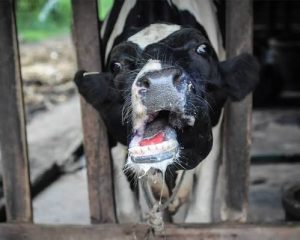
“All the seven FMD Varieties including SAT 1, SAT 2, O, A, C and Asia 1 have the same symptoms, with wounds on the cattle’s hooves then wounds in the mouth and tongue and there will always be a milk production drop. But, this SAT 1 strain has really affected the major milk production areas ever since the outbreak,’ said the industry expert.
“Currently, it is considered that 50 per cent of the milk production drop is because of the FMD outbreak and the other 50 per cent because of drought, but there have always been drought months every year and there has never been such a huge milk production drop leading to the shortage currently being experienced,” he said.
“A good example is one of our cows in Limuru, Kiambu County, which had been vaccinated, but still showed symptoms of the FMD. While the cows did not have wounds anywhere, there was a milk production drop. There was one that was giving us 12 litres and it dropped to 2 litres only,” he said.
“You know when the cow’s milk production went to 2 litres, it was so shocking..and we checked and found the virus was there. It was very weak, but it was there. The cow was quarantined and even the whole farm quarantined and after about three weeks it has now gone to 8 litres, which we hope that, at least after two months, it should have gone back to normal milk production of 12 litres.”
The drops have been similar in Githunguri, Kenya’s largest milk producing subcounty, where milk producer Fresha, which sources all its milk from around the subcounty, has suffered a 40 per cent drop in milk production from its more than 11,000 farmers.
“We are experiencing a shortage of milk and the main reason is FMD. We get milk from different farmers and their cows have been affected by the disease. Like, generally, all the farmers,” a contact at Fresha said in an interview with FarmBizAfrica.
“Their milk supply to us has dropped by a lot, like half of it… We don’t have the exact numbers on our end at the moment, but I can give it as a percentage. It has dropped by 40 per cent between the end of July and today.”
Many of the country’s leading milk producing counties have been effected , according to the expert source. “The major thing was to identify the strain because it has really ‘disturbed’ … because major farms were hit in Nakuru, KItale, Nyandarua, Nyeri and Kiambu among others,” he said.
The outbreak is only now being acknowledged by government.
On 3rd September and 19th September, Jonathan Mueke, Principal Secretary for Livestock Development, announced the milk shortage was due to drought, adding earlier this week that it had also been driven by cooperatives underpaying farmers.
It is not clear whether the state department had been unaware of the outbreak until now, despite five public, professional and industry organisations, farmers, and producers having all confirmed its details to FarmBizAfrica over the last month.
However, today, the state department issued a statement confirming that there had been SAT1 and SAT2 outbreaks since July across Trans Noia, Uasin Gishu, Nandi, Kisumu, Baringo, Kiambu, Kajiado and Nyeri counties.
The department said it was now heightening surveillance, while, according to experts, SAT1 has now been set as the top target for vaccination.
“In the future, that is the strain vaccinations will be dealing with most because even if the others come, they do not last long and they are never as deadly as SAT 1, which has killed lots of cows. There are farms that have lost up to 50 per cent of their cows,” said the industry expert.
Moreover, while the quarantines and lockdowns have been limited in terms of the counties that have acted, those that have, such as Kiambu, have imposed very strict measures.
“This is what forced a lockdown even in veterinary officers and not just livestock and its products’ movement from one county to another. So, actually, the lockdown was specifically for the veterinarians too. They would only be allowed to reach the gate where the farms had placed everything for you. You would leave your cars very far,” he said.
“Two doctors would only be sent to go and collect the samples and get the overview. But, generally, Kiambu has been strict with the lockdown and it has had a greater impact at the end of the day, because the normal production will be back, as it has already started.”
The Directorate of Veterinary Services has, meanwhile, today called on farmers to vaccinate their livestock, observe quarantine measures, avoid unnecessary visitors, and disinfect anything reaching cattle, as FMD is highly contagious and viral.
Said the contact at Fresha: “We are hoping for the best, soon, but we can’t even predict when…At the moment, we don’t even know when things will resume to normal. We are just going with what we are receiving from the farmers.”
Currently, the Kenya Veterinary Vaccines Production Institute is producing FOTIVAX for the vaccination of livestock against FMD.
Free members’ zone
Get your farming news by email.
Free. Market prices, crop news and farmer opportunities, straight to your inbox.