
Kenyan wheat yields collapse on pest control ban for rust
By Antynet Ford
Kenyan wheat farmers are reporting severe crop losses to the disease rust following the banning of its main controls, with a drier end to the 2026 long season reducing the disease this year, but losses running at anywhere from 20 per cent to 50 per cent of their crops in every season over the last two years.
William Kikapel, growing wheat on 20 acres in Lower Melili, Narok said the disease had cut his harvest by over 50 per cent in a single season, reducing his expected average of 20 bags per acre despite repeated rotation of pesticides.
“The most challenging bit of farming wheat and what has really affected me in the last two seasons is wheat rust. Especially last year, when there was a lot of rain and I lost ten bags per acre of my 20 acres. The rain was too much,” said William.
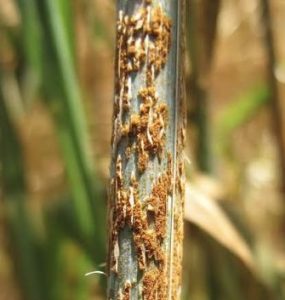
Wheat rust needs a film of water on leaves to germinate, meaning continuous rain makes the disease more virulent, but the spores are nearly always present on Kenyan wheat farms, with now no pest control effective in clearing them.
“While there are pests that also affect the wheat, at least they respond to the pesticides I spray and they get eradicated. Rust has been a pain and as the pesticides available for use are not working. Even if they work, they become resistant and no longer work,” said William.
“And the 50 per cent loss per acre is because of my strife, otherwise, with rust, a wheat farmer can lose everything and harvest zero,” he said.
“While I had been previously harvesting 20 bags per acre making a total of around 400 bags on my twenty acres, last year, I just harvested 200 bags only. In an acre I was getting 10 bags and even lower. It is all because I kept trying by alternating the available pesticides, as the others, as advised by an agronomist, they were banned.”
“The ones available are really not clearing out the rust completely, but just managing and reducing the loss.”
“This year, I lost maybe 2-5 bags per acre which is not bad, because the rains were not much. The only thing that was bad with the weather was the rain patterns, which were not consistent. So while we still do not need lots of rain as wheat farmers, we need it for the crop growth, though, when it is too much, the rust is higher hence much losses,” said William.
“In terms of money, it is a lot being lost, because if you calculate, say just even at Sh4,500 per bag that we are used to selling it, it goes upto almost a million because it is Sh900,000 lost with half of the wheat being destroyed by the rust,” he said.
He is also spending more on pesticides with the effective controls removed, last year spending almost Sh100,000 on fungicides to control the disease, but less this year because of the long period of dry weather.
Altogether, costs and losses have soared, said William, since he began farming wheat in 2021, and without pesticides that are working.
“Rust has been there since I started farming but it has increased in the last two years and…much has really changed in terms of production, starting with the market, lots of diseases and pests, and the price for pesticides has vastly increased too.”
“If you try to look at even the price of the fuel used in tractors that we use to harvest and plough the land, it has almost tripled on what it was when I was starting five years ago. Lots of things have led to a hike in the cost of producing wheat,” he said.
This has seen some of his neighbors abandon growing wheat for maize, finished off by the impact of rust and of birds.
“When the wheat is ready, the birds know it first, even before us, and they eat a lot. In a day, birds can eat even an acre of wheat. It is the second most challenging thing, after rust. You know, previously, we have been harvesting a lot of wheat, but these two have become a pain for us. In fact, some people have shifted from farming wheat to maize,” he said.
Get your farming news by email.
Free. Market prices, crop news and farmer opportunities, straight to your inbox.
Set county, crops and alerts
Become a free member so weather and saved tools follow your farm profile