
Makueni farmer uses seedling sales to build a citrus network
By Antynet Ford
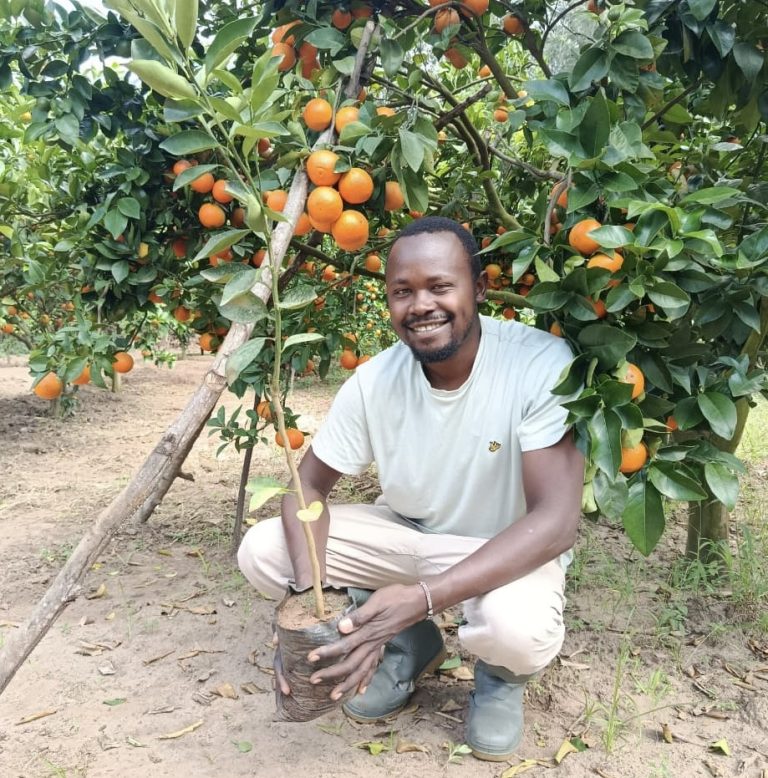
Gideon Kilo may have found a way to commercial fruit sales from just 3 acres of orchards by selling seedlings to enough farms to deliver, together, tonnes of fruit per week, positioning him as a potential aggregator, rather than forcing him to buy more land to get a commercial contract.
Selling to a steady buyer means producing big volumes, said Gideon, which he can’t from his plot in Makueni, leaving him stuck in a poor market, even as Naivas reports fruits as its fastest growth area in fresh produce.
“We never sell in bulk, like tonnes, because the farm is just three acres, which is small,” he said. BBut the result of his small volumes has been low and flat prices.
“Comparing the prices when I started farming these citrus fruits, and now, they have not improved; they have remained the same…Since 2020, the prices have been the same even for seedlings and for the fruits, as it has been averaging Sh100 per kg for pixies, lemons, tangerines and oranges, and Sh150 Sh200 for the seedlings,” said Gideon.
“High-end grocery stores like supermarkets and other retail and wholesalers would be a good and better market, but it is hard to get such orders.”
Instead, he has built a business selling seedlings through friends and social media, in trade that may now also have given him a way into commercial fruit sales.
“At the Two Brothers Farm, we are propagating the seedlings, which we are selling at Sh200 per shilling. We have a demonstration farm where we produce fruits, including pixies, oranges, lime, lemon, and tangerines, for sale, with the biggest customers being those who come to buy seedlings and learn how to grow fruits in the citrus family. Most of the buyers are those who want five, 10, or 20kg,” he said.
“We have customers daily, who sample the fruits first before buying, so 3 acres is not enough to produce lots of fruits to sell in bulk. I mainly focus on my clients who come to buy seedlings, and they are the ones to whom I give first priority, because if a client comes to buy seedlings, they want to see if I have planted the trees myself and if they are producing well.”
Sometimes brokers come to the farm looking for large purchases of fruits, but the prices are low, and not worth the shift, if it harms his seedlings business.
“My biggest fear of selling all the fruits in the 3 acres is always that the seedlings business may go down because it is the main anchor of the seedlings business. People buy the seedlings when they see them doing well in my farm as they taste, then buy a few fruits for their take home,” he said.
“I get most of my fruit and seedling clients through referrals from those who have bought fruits and seedlings at the farm before. But I am also very great at social media marketing and I properly use the platforms to get customers who buy a lot too. But those also passing by the Wote-Machakos road, where I have an outlet I get to sell there.”
“On bad days, or let me say off season, I have at least 100 to 200 customers in a week. I get orders from all over the country, but mainly the lower eastern and coastal region is my greatest custom,” said Gideon.
But his seedlings business may now be opening new opportunities for him in fruit sales too.
“If I got an order to do a supply every week or month, a regular market that is, I will supply now, because I have been growing the trees for the last six years. For the years that I have also been propagating seedlings, there are people who have been buying the seedlings, and their trees are already producing fruit. If I’m to get an order exceeding what I have in my 3 acres, I will look for a supplement from them and ensure that I get to supply what has been ordered consistently. These trees are producing well, and I also have a network of farmers around me who can help me fulfill the demand,” he said.
But the regularity of the sales matters.
“Prices in some months, including May, June, July, and August are always higher than in November and March, mostly because between March and November, there are always oranges from Tanzania, where the production cost is lower than here in Kenya.”
“It is easy to see oranges from Tanzania as their variety has few seeds inside, unlike those grown in Makueni, which have no seeds. All the pixies are from Makueni.”
His biggest challenge is some pests affecting the production of his trees, which, according to him, are due to climate change, as they were never there before, but have been attacking some trees with some diseases, even making some trees to wither costing him a lot.
“Apart from that it is good business and has good returns compared to farming normal crops like maize and beans as others do. Let those in fruit businesses attend trade fairs, keep pushing their businesses online, too, as I do and it shall be big and better,” said Gideon.
Get your farming news by email.
Free. Market prices, crop news and farmer opportunities, straight to your inbox.