
Nakuru blueberry farm cuts thrips by 50% with Sh60 sticky cards
By Antynet Ford
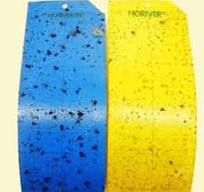
A blueberry farm in Nakuru has cut its thrips infestations by 50 per cent in the last two years, and saved Sh100,000 per greenhouse on pesticide costs, by switching to yellow and blue sticky cards to control the destructive pest.
In an interview with FarmBizAfrica, William Opiyo, the manager and agronomist at the three greenhouse farm, said the cards, which cost Sh60 to Sh80 each, had saved costs per greenhouse of around Sh100,000 a month on sprays to control thrips, aphids and fruit flies.
“The cards have helped us deal with thrips by around 50 per cent, leading the fruition to be greater, as most of the flowers are saved from destruction,” he said.
“You can farm the blueberries without the fly traps, but now you will have to be spraying every month to control the pests, like thrips and mites. We use the sticky cards as an alternative as we are trying to minimise the use of pesticides because the fruits may have pesticide residues when we harvest for sale and that may impact the consumers. We always want to produce organically and that’s why we use the traps,” he said.
“The use of traps is cost effective because for the three months that the blueberries take to mature, we are not changing it, but, if we are spraying pesticides, it would be expensive, as it needs different pesticides, for different pests, every month.
“The pesticides are way more expensive,” too, he said “by around 80 percent, while the traps costs between Sh60 to Sh80, which is fairly manageable, while the pesticides cost thousands and must still be bought and spraying done on a monthly basis. Also, it is expensive as you need to get the protective gear as, if you do not use them, you’ll end up getting sick and using more money for treatment,” said William.
The farm uses the blue and yellow sticky cards, which he explained work differently, for different pests.
“All of them work differently as the blue one attracts thrips through its reflection of light inside the greenhouse. Thrips ‘love’ the blue light color and that’s how they get to the cards and stick there,” he said.
“The cards are placed when the blueberries are nearing flowering, which is at the fifth month, when they start the flowering.”
“We leave them there until we harvest three months later, as blueberries have one season only, which takes eight months,” said William.
“As long as the card has not been in contact with soil or water it stays there for the rest of the season, as the gum on the cards is strong enough to last for the three months when we harvest.”
“We change it when we are rotating with another crop at the greenhouse and that’s how the cycle continues, even with the rest of the crops that we interchange with the blueberries; the use of the fly trap cards varies depending on the crop,” he said.
“The cards are not placed on every plant, but in a zigzag wave inside the whole greenhouse. It is not like the FCM traps that are used by avocado exporters, who place it per tree. Though I haven’t counted how many we use in a single greenhouse, as long as it covers the whole of it in a zigzag way properly, you are good to go. You just ensure that there is no part that’s left uncovered,” he said.
The end result has been a much fuller crop.
“Currently, we are selling locally to retail shop, who are our main customers, because we are not producing enough to export. In the future, very soon, we shall be getting into the international export market, once we increase the production,” he said.
Get your farming news by email.
Free. Market prices, crop news and farmer opportunities, straight to your inbox.