
Nyeri farmer reports jump in arrowroot prices, growing dryland tubers
By Jael Maunda
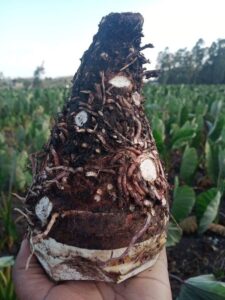
Arrowroot prices have jumped since last year, by over 80 per cent for peak prices, said Nyeri farmer Mary Dirango, who earnt profits of Sh200,000 per acre for the crop last season.
Mary Dirango, who is growing a high-yielding and quick-maturing drought-resistant Dasheen variety from Rwanda, said this year’s prices were the highest she had seen in 15 years of growing the crop.
“I sell my arrowroots per piece. One piece this year was going for between Sh50 and Sh150, depending on the size of each, while last year it was going for Sh50 to-Sh80 per piece. This season, I made a profit of about Sh300,000 of the arrowroots I planted on the one-and-a-half-acre piece of land after all the deductions from production costs, looking at my calculations.”
“I realized that selling them per piece, one earns more profit than selling them per kg,” she said.
Her switch to the Rwandan variety has also seen her earn extra for suckers.
“i visited Rwanda and found this specific variety, which does well in upland areas where there is little water. I planted them, they multiplied, and right now a sucker is going for Sh50 compared to last year which was going for Sh30 per piece.”
“This year, alone, I have sold over 50,000 suckers to farmers at an expo that was held in Nairobi, last month. Farmers like them because of their uniform tuber size and taste.”
Demand has been strong for arrowroot for over a decade, as hotels and consumers switch to the tuber as a breakfast food. But the growth in production has been slowed by a shortage of planting materials.
The Rwandan Dasheen is adding new production, however, taking 6 months to mature in dryland compared to the Kenyan traditional varieties, which take 8 months to mature after transplanting. Arrowroots are known to do well in waterlogged areas, but the Rwandan variety does well in upland.
“Arrowroots can do well with a good soil. In Nyeri, it is red soil and it does so well, I dig individual deep holes in lines of 2 by 2 feet, add enough manure, and mulch them,” said Mary.
As a breakfast food, Arrowroots have been rising due to high nutritional value, with the tuber proving energy, fibre, vitamin B6 and C. Demand has also risen as the tubers are increasingly used by producers to make flour, which is used to make porridge.
The rising prices for wheat and bread are also accelerating the changeover.
“Many people are moving away from bread. The demand of arrowroot has risen. Customers are always ready. Immediately you harvest them, they purchase them. Since I started planting arrowroots, I have never made any loss since they are rarely affected by pests and diseases. i have been planting them for over 15 years,” she said.
Mary is now planning to expand her farm acreage,since the demand is increasing.
Get your farming news by email.
Free. Market prices, crop news and farmer opportunities, straight to your inbox.
Set county, crops and alerts
Become a free member so weather and saved tools follow your farm profile