
Processor recruiting ‘000s of cocoa farmers to make chocolate in Kenya
By Marion Achieng
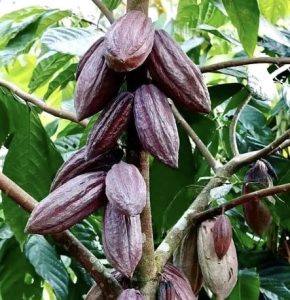
A DRC cocoa processor setting up operations in Kenya is seeking new and existing cocoa farmers countrywide, offering offtake contracts for, eventually, thousands of acres to supply its forthcoming Kenyan processing plant. It will be buying wet beans from smallholders to make chocolate in Kenya.
The move by Kenyan investment firm Chambers Federation to stimulate and buy the cocoa grown in Kenya comes seven years after it launched a similar programme in the DRC. It now processes cocoa from 3,000 farms across 15,000 acres at its plant in Beni, Eastern DRC.
In Kenya, it plans to go further to produce a new, locally sourced chocolate brand, beginning with a planting programme, said Chambers Federation Senior Technical Lead Matthew Chambers, in an interview with FarmBizAfrica.
“We are prepared to provide offtake or purchase agreements to farmers now. This is an important part of our approach. We don’t want to encourage farmers to invest their land, labour, and several years into growing cocoa only to discover later that there isn’t an established buyer… If farmers are prepared to grow quality cocoa, we are prepared to help establish the market that buys it,” said Matthew.
The firm is also seeking out existing growers.
“If farmers already have mature cocoa producing pods this harvest season, we want to identify them immediately. We can begin visiting farms, documenting growing conditions and planting material, evaluating production, and working with the cooca through controlled fermentation, drying and chocolate-making trials,” he said.
Chambers Federation’s contract offer comes just weeks after the government launched a cocoa growing initiative in the country, announced by Depuy President Kithure Kindiki on July 11th.
Forestry Principal Secretary Mugambi Gitonga said at an investment forum in Nairobi that the government had identified some 5.9 million hectares suitable for cocoa production, and planned to distribute two million cocoa seedlings in 2026.
Cocoa thrives in warm, humid conditions, making key zones in Kenya ideal. It can also be combined in layered farming with tree crops such as avocadoes.
“There are some zones in Kenya that have potential for growing cocoa. Think of coastal areas, where it’s going to be humid…You can’t grow cocoa in Turkana, it’s not going to work. Potentially around Kisumu, the northern part of Migori. It depends a lot on your rainfall, so if you are not getting enough rainfall or enough consistency in your rainfall then you might want to irrigate,” said Matthew.
But farmers have already been planting for some years, following the launch by the Kenya Agricultural and Livestock Research Organisation (KALRO) of cocoa seedling sales, and projects in areas such as Meru.
“If someone is already growing cocoa anywhere in Kenya, whether they have mature producing trees, young trees, or recently planted seedlings, we would like to hear from them. We’re particularly interested in learning when they planted, where they are located, how many trees or acres they have, what varieties they are growing if known, and whether they have already harvested cocoa.”
The firm needs to establish supplies from a minimum of 250 acres to begin production, but then plans to ramp up quickly. “We would ultimately want production to move into the hundreds and eventually thousands of tonnes annually,” said Matthew..
In the DRC, the firm now processes a peak of 2 to 3 tonnes per day of dried, well-fermented cocoa beans having worked with the CODE Femmes women’s co-operative to build up planted acreage around Beni, the current capital of North Kivu province in the east of the country. The cooperative’s smallholder farmers provide wet beans that the firm dries and ferments.
For Kenya, “as an initial benchmark, I would aim for around 100 tonnes of good-quality dry cocoa per year to be commercially meaningful. At mature yields of roughly 500kg to 1,000kg of dry cocoa per hectare per year, that would require approximately 100 to 200 hectares, or about 250 to 500 acres under productive cocoa,” said Matthew.
But this is as a total. “Our model is primarily smallholder-based, so this could involve hundreds or thousands of farmers incorporating cocoa into existing farms,” he said.
The federation’s payment rate is then driven by global pricing.
Currently, in DRC, “we look at the prices on the international market, add around 500 Congolese Franc then divide by three. If, for example, the price is $9 per kg, we add the 500 Francs and divide by three, so that is (add) $3 per kg.”
“As a general conversion, approximately, 2.7kg of wet cocoa beans produces 1 kg of dried cocoa beans in our current operations,” he said.
To organise planting and offtake contracts in Kenya, farmers, farmer groups, cooperatives, county governments, and organisations involved in existing cocoa initiatives can contact Chambers Federation by email on cocoa@chambersfederation.com, or WhatsApp +254 112 934 289, and social media @chambersfederation.
Get your farming news by email.
Free. Market prices, crop news and farmer opportunities, straight to your inbox.