
Tanzania dominates ginger as Kenyan farmers held back by clay soils
By Antynet Ford
Agribusinesses in Nairobi are buying ginger from Tanzania and Uganda, adding transport and customs costs, due to the shortages of the crop in Kenya, which cannot thrive in clay soils.
Ginger is being widely promoted in Kenya, including by FarmBizAfrica’s HarvestMAX farm planner, but remains in chronically short supply in the market.
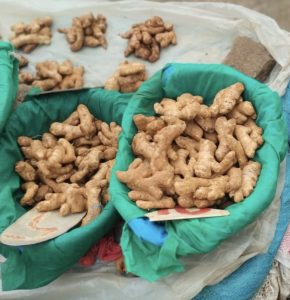
Speaking to FarmbizAfrica during a ginger market tour at the Marikiti market of Nairobi, ginger trader William Sempheho said the constraint on Kenyan growing has been the country’s red clay and black cotton soils, which retain water.
“If the soil holds water, ginger will rot and the farmer will make losses as it does not need soil holding water,” he said.
Up to 60 per cent of smallholders’ farms in Kenya are on clay soils, meaning the market opportunity for ginger is there for something under half of the country’s farmers.
With limited supplies yet available, William, together with his friends, have joined together to buy ginger from farmers in the Moshi villages, Songea, Kigoma, Tanga and Morogoro areas of Tanzania and partly from Chavada area of Kampala Uganda.
They needed to join forces, he said, because the importing needed up front capital, and carries costs so high that it creates a financial risk. Only by working together can they sustain the losses that follow some imports.
“So, for example, if I have Sh300,000 as capital, after doing the rounds at the market, getting the produce from the farm and paying the tax, you get that I may have just got Sh150,000 after the sale is made, which is half of the capital that I input… So, at times, instead of the capital rising, you get that you may make losses because of the rounds and the taxes you are paying. That is why we have come together with my friends to do it together and see the expenses go down and increase our profit,” he said.
They also often have to cut prices.
“You have to be smart to make profits. At the market, the competition is high and we are always competing on who is selling a bit lower to ensure that there produce goes faster so that they can get cash and go back to the farm and get more. The lower you sell; the better changes you have of selling faster. I have to reduce by even ten shillings to ensure that I sell because if I have the same produce for more than two weeks that is long enough and I may make more losses if I do not drop the prices as those who come to buy want something fresh,” he said.
William and his friends also import from Chavada, Kampala, but importing from Tanzania is better than from Uganda as they can get higher volumes as the lorries are larger.
“A single lorry from Tanzania carries 16 tonnes…Kampala vehicles carry only upto 5 tonnes maximum as they are smaller vehicles compared to the ones that come from Tanzania,” he said.
Quantities and sorting are also simpler.
“For the one that we get in Tanzania, we buy it in kilograms and the one from Uganda is bought according to the size of the sack, say the 50kg, 70kgor 90kg sacks. For them, the sack is filled with ginger and as the buyer you are told that for this one we shall sell it to you at Uganda Sh300,000 or Sh350,000; it depends with the quantity of the ginger packed. If it is during the harvest season for ginger, the price is always lower and during the off peak the prices are always higher, as, at times during the off peak, it gets up to Sh600,000(Ugandan),” he said.
“For Tanzania, we get it in kilograms, the farmer harvests in their farm and puts it on the 50-100 kg sacks then takes to a centre near the main highways where the kilograms are measured and recorded and after finishing the weighing, the kilograms are added up.”
“In Tanzania, after the weighing, as the buyer, after you have been given your package by the farmer, and after you have paid, you pour the whole package in a tent and sort the ginger according to sizes. The larger ones are the ones that are repackaged in the sacks for transport to Kenya for selling here at Marikiti. The smaller ones are normally sold there in Tanzania for the processing of the dry ginger or, at times. we still come of it to those people who make fresh juice. The thing is, for the small sizes, the market is smaller. So for Tanzanian ginger, you have to sort and remove the smaller sizes and take the bigger ones.”
“The ones you are seeing here are the larger sizes that were packaged and transported for sale here in Kenya, though when there is no market for the small sizes in Tanzania we also come with them to Kenya and sell to fresh juice vendors. Most is bought by the fresh juice processors, even those factories that make industrial juices that need ginger. For them, size does not matter to them that is why they take the smaller ones,” said William.
Get your farming news by email.
Free. Market prices, crop news and farmer opportunities, straight to your inbox.