
Government finds maize growing causes farmer poverty
By Marion Achieng
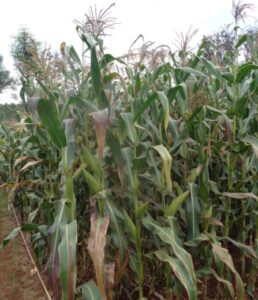
The government committee charged with planning Kenya’s 2026 Mazingira Day celebrations has found maize has the lowest profitability of seven crops reviewed, earning a farmer only Sh15,000 per acre, compared to up to Sh500,000 per acre for key tree crops.
A report reviewed by the committee earlier this year compared farmer earnings from staples, including maize, wheat and potatoes, to tea, coffee, avocados and cocoa, finding that farmers growing maize earn only poverty incomes.
Its estimates showed Kenyan farmers typically earned Sh60,000 an acre from maize, but spent around Sh45,000 an acre to produce it, leaving farming families with just Sh15,000 or $115 a year of income.
The government’s calculations were based on farmers harvesting 24 bags per acre, compared with the existing average for the country in 2024, as reported by KNBS, of 7.5 bags per acre
Yet even at the committee’s higher yield estimate, maize farmers are earning just Sh1,250 a month per acre for maize, compared with estimated cocoa profits of Sh552,000 per acre per year – or Sh46,000 per month – and avocado profits of Sh400,000 a year.
Following the committee’s focus on the far higher earning potential of cocoa, President William Ruto officially launched this year’s Mazingira Day celebrations with a cocoa seedling distribution in Endebess, Trans Nzoia County, at which he urged farmers to grow the crop in every area the government had mapped as suitable.
Yet over 90 per cent of Kenya’s farmers continue to grow maize, which is a staple food spread in the twentieth century by colonialist settler farms.
Kenya delivers maize yields more than 10 times lower than northern hemisphere yields, while the UK no longer grows the crop for human consumption, but almost solely as animal feed.
However, the legacy of maize as Kenya’s staple has also put in place a mismatch with African soils and climates that is getting worse as climate change progresses. A study for the VACS (Vision for Adapted Crops and Soils) partnership of the US, African Union, and FAO predicted that maize yields will fall faster than any other cereal as the climate gets worse.
These falling yields, as well as flight from the crop, are already having an impact.
In an interview with Nation last month (October), Cabinet Secretary for Agriculture Mutahi Kagwe said Kenya consumed 70m to 75m 90kg bags of maize a year.
But, from 2020 to 2025, it produced an average of 40m bags, according to KNBS, causing a deficit that has been covered by imports from countries such as Uganda, Tanzania, and Zambia.
In 2026, the government plans to import a further 25m bags, equivalent to 2.25m tonnes, in a steep jump on import levels that have anyway been rising rapidly.
That climb, while worse when the weather is extreme, is set to continue as long as farmers are earning almost nothing from the crop, and face much better alternatives.
According to the KNBS 2025 Agriculture Report, “while maize continues to dominate, crops like Irish potatoes and cassava standout for their high productivity despite limited cultivated area”.
The Mazingira report estimated farmers can earn profits of Sh180,000 per acre for potatoes, although potato yields have fallen sharply in the last two years since the main fungicides were banned for potato blight.
But it estimated potential earnings from coffee even higher, at Sh300,000, topped only by avocados and cocoa.
The government is now targeting one million acres under cocoa production by the year 2032.
The cross departmental 2026 Mazingira Day committee included Philip Lemarasia of the State Department of Environment and Climate Change and Felix Kisalu and Susan Boit from the 15Billion Tree Secretariat.
Increasing production of cocoa, as a tree crop, will contribute to the government’s goal of raising national tree cover to 30 per cent by 2032 through the 15Billion Tree Growing Programme.
According to the Mazingira Committee it also makes financial sense.
“The proposed Kenya Cocoa Strategic Roadmap demonstrates the transformative potential of cocoa, estimating that scaling production to 5.9m hectares could generate between Sh3.1 and Sh6.1 trillion annually, depending on productivity levels,” read the review report.
Get your farming news by email.
Free. Market prices, crop news and farmer opportunities, straight to your inbox.
Set county, crops and alerts
Become a free member so weather and saved tools follow your farm profile