Ken Meat recovers from dip on war, but reports flat meat exports
3 min read
By MaryAnne Musilo
Kenyan meat exporter Ken Meat reports sales volumes from Kenya have returned to pre-war levels, but with no evidence of any underlying growth in the market, even as the government targets sharp rises.
“Right now things are back to normal and my prayer is that it remains as it is:” said Joseph Nyarotso, the Managing Director of Ken Meat, after major setbacks caused by the war in the Middle East, which saw air freight costs jump from $3.5 to $5 per kilogram.
Ken Meat, which runs its own slaughter house and sells meat locally and to the Middle East, has now managed to restore its export sales to its regular levels of 5 tonnes a day.
Kenya only currently exports meat to the Middle East and across Africa, as its animal disease control and low quality have seen it locked out of middle and upper-end meat markets, including wealthier consumers in the Middle East, and all of Europe, on quarantine grounds. Some 85 per cent of irs meat exports are of goats and lamb, according to the Kenya Meat and Livestock Exporters Industry Council
“The biggest challenge that hit us was the price of cargo. It was really hiked to $5 per kilo. With the planes going to the Middle East being minimal,” said Joseph.
“We export around 5 tonnes per day. Our main customers are in Bahrain and Dubai. Getting the product there was really a challenge but we had to face it and pay the freight charges either way. We mostly use Emirates SkyCargo. During that period we tried getting other lines, but they were all up. Others charge up to $6. There was no difference and the goal was to export so that we are not left with the meat in our cold room stranded,” he said.
Ken Meat buys from farmers across East and Central Africa. New farmers are welcome to contact the company to start selling too, he said, but there was not, currently, growth in the market.
Kenya’s meat is generally considered to be of lower quality than elsewhere in Africa, frequently because of its lack of traceability, with Kenya selling goats to Dubai for about Sh10,000 while Botswana, with an established traceability system, selling comparable goats into Europe for about Sh24,000.
But Ken Meat works tightly within the nation’s existing quality controls.
“We get cattle, sheep and goats from our suppliers. We have developed strong and long-lasting relationships with our suppliers and they, therefore, facilitate us in selecting healthy animals and high quality herds. Through this we are sure we get good quality meat,” he said
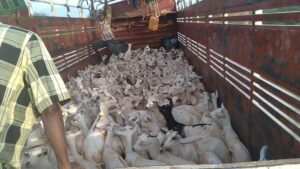
“Once purchased, the cattle are collected and transported to our slaughter house in Athi River by trucks.”
Joseph said it was important, however, to inspect if the animals are in good health to be slaughtered.
“We have a government veterinarian who inspects each animal after they arrive in the slaughter house and they are then marked. The ones marked are the ones to be slaughtered and this gives us an easy way to track the animals until they are slaughtered,” he said.
“Then the health officer checks if the carcass is good for people to eat and stamps it. After the carcass is stamped we store them in our chillers and later they are taken to the airport,” he said.
Their standards are tailored to satisfy Middle Eastern border authorities.
“We are certified by recognised Islamic bodies like the Horn of Africa Livestock Improvement and Conformity Services and the Kenya Bureau of Halal Certification (KBHC),” said Joseph.