
Gilgil farmer expands water harvesting for El Niño as new income
By Antynet Ford
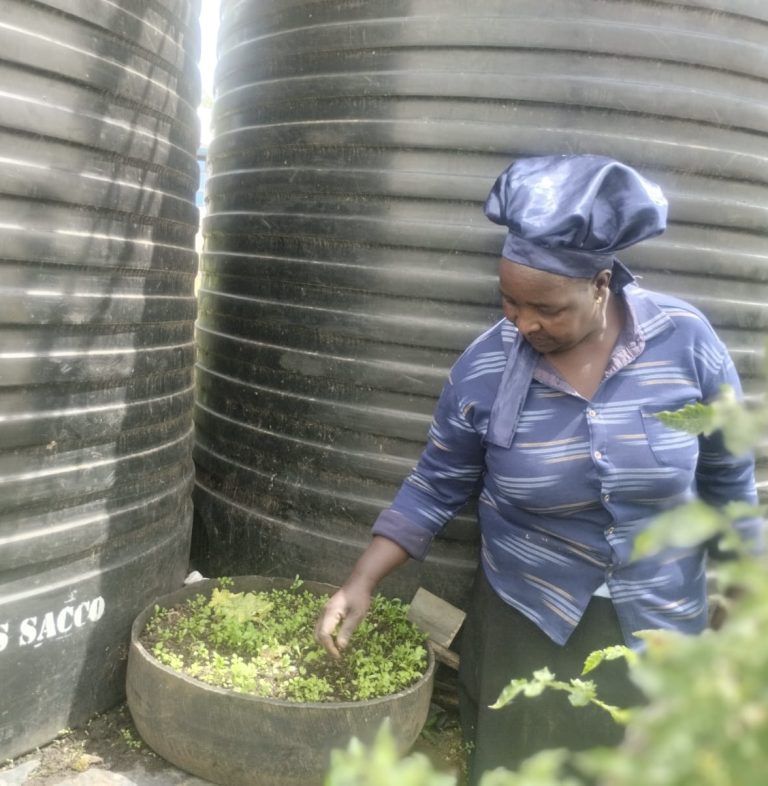
Beatrice Wangui has built up 80,000 litres of rainwater on her Gilgil farm, running it all year with the water, and is now buying two 10,000 litre tanks to collect more during El Niño to supply neighbours who presently walk 3km for water.
“Before the El Nino rains, or even the October November December rain Season, I will have added two 10,000 litre tanks to get to 100,000 litres of water collection here at my farm. The extra 20,000 litres is for selling to the community that lives around me. They struggle a lot to get water from the stream, which is 3 kilometers away,” she said.
For a decade and a half, Beatrice struggled with farming on rocky land as the Langalanga terrain made it nearly impossible to drill a borehole. The one borehole that was many kilometers away was salty, and there was no chance of piped water from the county government as they were charging Sh4000, which she said was too expensive for a smallholder farmer.
Relying on erratic rainfall made water scarcity a constant challenge for her home and farm, until she began water harvesting, with 2026 being the third year since she last bought water from the stream 3km far away.
“The motivation to collect my own water was after I was educated that I could collect water using gutters fitted on my house. I started with a 5000 litres tank alone, it was only from one roof, unlike the many you are seeing here. So at that time, the 5,000 litres was only for drinking and cooking. It wouldn’t last long.”
“Slowly I added more jerrycans and more tanks and by around the COVID-19 period I had enough water collecting for use in the domestic chores, but not for washing. I would still go to people’s homesteads (those with County Council water) to beg for water for washing clothes, but because they are human, they would get tired.”
“Three years later (in 2023), I got to a point where the water collection was enough collecting from bigger roofs and now three roofs where I have been collecting enough water for a year long. The water is for irrigating my crops, showering, kitchen use, washing clothes and much more,” she said.
She added to her six 5,000-litre water tanks a 30,000-litre underground water tank and has kept adding, because her tanks are always full with a month of consistent rain meaning she can easily collect more.
“When the long rain started this year, for example, within a month all the tanks were already full. That is when I added a dam liner and another two 5,000 litres tank. After that, there was an over flow all through and that is what made me to start thinking of how I can add more tanks and make an income from it.”
“Currently, I collect 80,500 litres of water, with the 30,000 litres underground tank, 20,000 litre dam liner for farm irrigation, 200 jericans of twenty litres, I have 1000 litre drums and six 5,000 litre tanks that I collect the rain water with,” she said.
Meanwhile, collecting from the stream has got harder for those around her. The stream was at some point closed by a private person and locals can only access the water at night starting at 8pm. “I already used to spend almost a whole day to get just ten jerrycans, which lasted barely two days,” she said
“Some neighbors have been asking if I can sell them water, but I could not, because it has only been enough for me and my household. But now, when I add the two tanks, I will be good to sell to them and make an income.”
“I will not charge my community a lot like they are being charged Sh30 bob to see a single 20 litres jerican filled with water from the stream and transported to the homestead. I will just be charging the normal Sh10 per 20 litres then they carry it on their own.”
“That will have cut the cost for them by two thirds. For me, I will have increased my income as I also sell indigenous vegetables and seedlings; so this is an extra income,” she said.
Get your farming news by email.
Free. Market prices, crop news and farmer opportunities, straight to your inbox.