
Nakuru farmer sweeps away pests with Mexican Marigold after chemical burn
By MaryAnne Musilo
A Nakuru cabbage farmer has pulled off a Sh2,000 saving per season on pesticides by replacing his chemical sprays with Mexican Marigold after a pesticide burn left him with a Sh3,000 hospital bill – joining a growing league of farmers pointing to the weed as a nearly complete pest cure.
Farming around 5,000 cabbages a season, for around Sh100,000, in Kiambogo, Nakuru County, Paul Kimani is now building his pest control into his crop by planting the weed around it.
“I started growing cabbages in 2023. At first I used to spray any pesticide that worked. Seeing that my crops are pest infested, I became used to the agrovet and would buy any pesticide that they would advise. Mostly I used around Sh2,000 on the pesticides. It used to work. The Acetamiprid was effective, but after watching a documentary online on how chemical based pesticides are dangerous and can harm people’s health, because I sprayed and it burned my skin on my right arm – although to be honest I never used protective gears when spraying – I started researching ways to practice organic farming,” he said,
“I went to the hospital when I got that skin burn. It was not big, but I was given creams to use at a cost of around Sh3,000,” he said.
“I learned that Mexican marigolds work well on repelling pests. I remembered when we were young, we used to cut them and hang them around the house to get rid of houseflies. But I did not get how I was to use it to repel pests. I didn’t understand how I would intercrop.”
“This is when I called an agronomist I knew and I asked him how to do it. He said I can plant inbetween my cabbages, but since it is a weed, I could used the other one, which people plant at home as flowers. I had the flower and I got the seeds and I decided to put that knowledge into work.”
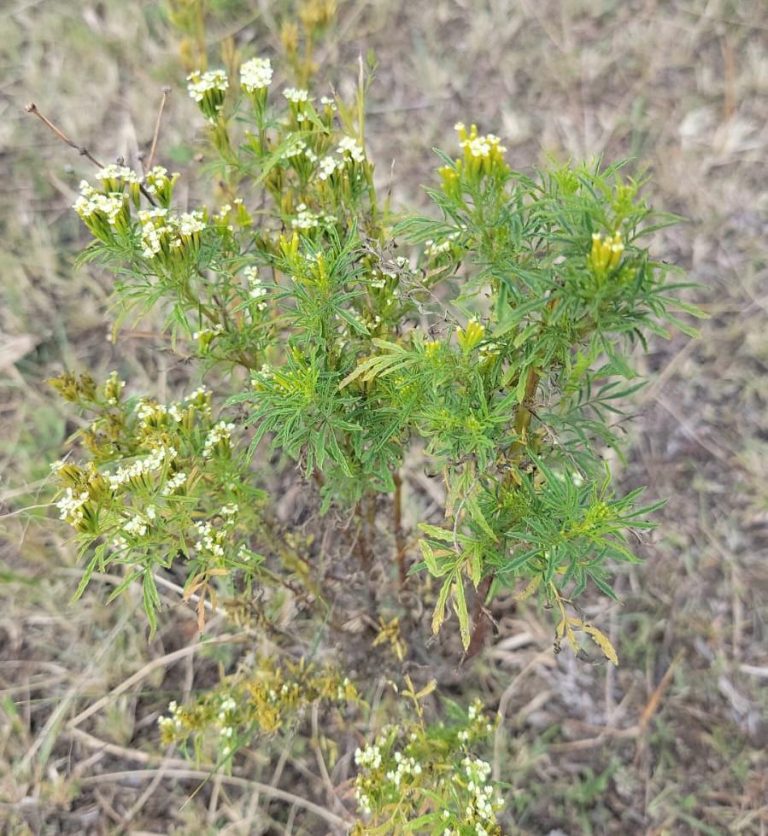
“The weed repels cabbages, aphids, caterpillars and moths. I plant the cabbages in four rows and on the fifth row I plant the weeds. I then plant it along the borders. I don’t let it flower, because when it flowers and generate seeds the seeds may fall to the ground and then it overgrows and it may be difficult to control,” he said
Mary Ngugi, an agronomist based at Murang’a county, recommends the weed as a repellent for many crops.
“Mexican Marigold, well known as Múbangi, is a plant that has a very strong smell. Some of the farmers I offer my services to exercise intercropping where they plant the weed inbetween the crops or plant it around the borders to repel pests like white flies. Mostly, to those growing French beans and tomatoes, I advise on having the weed just at the borders for when the pests come they will get the weed first and since they don’t like strong smells they are repelled hence not attacking the crop,” she said.
The weed also has other benefits. “It also protects the land from soil erosion. When there is heavy rain, it holds the soils and the soil won’t be carried away,” said Mary. Plus, “Mexican Marigolds have very beautiful flowers. This means they attract bees and pollination will take place and help in fruit formation. This is a very good plant to have, especially if one is growing fruits.”
The weed can also be used to deal with nematodes, a small roundworm-like pest that affects a plant’s roots by feeding on them, she said..
“In plants like tomatoes, nematodes can be very stressful to deal with. Nematodes are the big pimples like this that get to the roots. These are worms that feed on the roots and make the plant weak. So if tomatoes are intercropped with the marigold, it attracts the pests to themselves. The main crop in turn will not be affected,” she said.
Using Mexican marigold as compost or green manure can also add nutrients into the soil that help slow other diseases.
“Most crop diseases of fungus start from the soil. When the marigold grows, one can cut it off before it flowers and bury it in the soil. When it is buried in the soil, it decomposes, releasing nutrients like nitrogen, phosphorus and potassium to the soil and improves its fertility and will work best for the crop. So you will find that the soil is improved and if it has fungus, it is controlled, ” she said.
Get your farming news by email.
Free. Market prices, crop news and farmer opportunities, straight to your inbox.