Juja goat milk farmer reports galloping demand growth
4 min read
By Antynet Ford
At his farm in Juja, John Kabiru is producing 100 to 150 litres of goat milk a day,but can’t keep up with demand, as the milk’s health benefits drive up sales in his region faster than farmers are expanding.
“Goat milk is good for young children and people recovering from some diseases because it has medicinal value,” he said, “and the cost of production of milk for a goat is very low compared to a cow, because a cow is a heavy feeder.”.
It’s a combination that has already seen him increase his dairy goat herd from 200 to over 800 goats ad with Poa’s toads many more.
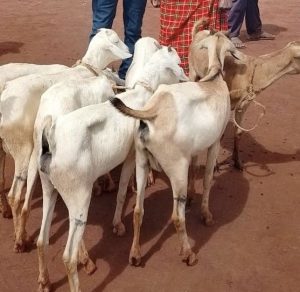
“I keep milk goats. We have Saussen, Toggenburg and the German and French Alpine. I started with 200 goats and we have a target of getting to 3000 goats, even though I also sell goats to farmers who want to start producing goats milk too. There is a market for goats’ milk, but I am yet to meet the demand and that is why I am saying we have a long way to go and that is why we have intentions of increasing the goats.”
In a day, I produce between 100 and 150 litres,” he said. But “the market is huge and we have not yet fulfilled it,”
“Clients are as far as Limuru and Embu. For pricing, a litre ranges between Sh200 and Sh300 depending on where we are delivering. Clients who are as far as Limuru and Embu, for example, we sell them a litre at Sh300. For those around Juja, they are the ones that we sell them a litre at Sh200.”
The price difference, he said, is for the extra delivery costs.
With his Saanen, Toggenburg, German Alpine and French Alpine goats, John is deliberate about breeding choices as he struggled at the beginning to get pure breeds, buying the goats from farmers who did not keep records of their breeding, which he now does keenly and has a system for.
“We just use the natural method in reproduction. We are not using Artificial Insemination (AI). It is because we are specific with the male goats that we want to use. When the goat gets between seven to ten months after birth, they can be taken for reproduction if well fed. If the breed that is ready for reproduction is German Alpine, I will always use its male counterpart for reproduction to maintain a pure breed. Because the gestation period is five months, you’ll always have two or four young ones as sometimes the goats gives birth to a pair (twins).”
He balances his milk production with the growth of young goats.

“After birth, the goat stays with its young one for a month without milking to ensure a fast growth rate.”
Once milking starts, “the separation is partial. The kid does not sleep with the mother goat and I milk it in the morning then return the kid to its mother where they stay together during the day. After two months we completely separate them and start milking in the evening and morning.”
“In the morning, before milking the goats, the pens are cleaned for good hygiene. We then milk at around 7am and later at 5pm.”
“You use warm water to facilitate the milk rate down. Then you oil the udder and start the process. Milking a single goat takes less than five minutes.”
Related News:
FAO delivers 2,250 Galla goats to Taita Taveta farmers to improve milk production
Galla goats deliver Sh40k+ each in nine months for semi-arid farmers
Ruiru farmer taps demand for goat milk in urban areas
“The milk is taken to a freezer then packed. Currently, I pack raw milk that has not been processed but I plan to process in future.”
John says that losses though minimal occur especially during transport when a motorcycle is involved in an accident or incident.
“Losses are sometimes incurred during delivery, especially when using a motorbike, but for long distances, we currently use a pick-up,” he said. He also sells goats and delivers countrywide.
For now, John just keeps expanding to meet demand, “I am planning some value addition to make cheese and yoghurt then get licensed to export later, but this is after I meet the target of 3000 goats.
Are you a farmer looking to grow the most profitable crop on your farm, with or without irrigation. Use FarmBizAfrica’s HarvestMAX on https://harvestmax.farmbizapps.com and it will tell you in less than a minute what the highest income-earning crops are for your weather, soil type and this season, based on your seasonal weather forecast. Don’t make weather losses ever again, and more than triple your income.