
Basil farmer fends off EU rejections on thrips by pre-plant spraying
By Antynet Ford
Farmer Mordechai Nyongesa is exporting high-return basil free of thrips, which are the biggest cause of EU rejections of Kenyan exports, by spraying his soils two weeks before planting, and constant scouting.
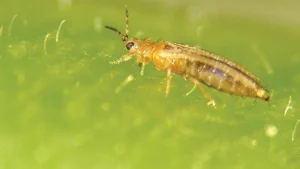
Thrips on basil accounted for over two thirds of the EU’s rejections of Kenyan fresh produce for quarantine pests in Q1 2026, at 68 per cent, and were far higher from Kenya than from neighbours Uganda and Tanzania.
“Thrips hide in the soil, so when I prepare my greenhouse for farming basil, I spray first to ensure, if there are any thrips hiding, they are all killed. I do the spraying two weeks before the planting day. From there, I monitor to see if they are affected by any pests, not only thrips,” said Mordechai who farms in Kirinyaga.
Thrips on basil accounted for over two thirds of the EU’s rejections of Kenyan fresh produce for quarantine pests in Q1 2026, at 68 per cent.
When thrips are found in a consignment, the exporter is prevented from sending any more exports until they have cleared the farm and been re-inspected, which is costly.
“I am aware that thrips is a quarantine pest in the UK and that is why I have been very keen in managing any small attack that I get to see. When they find thrips in a consignment, they will always trace and see where it came from and stop you from exporting,” he said.
“The first sign you will notice if your basil has been attacked by thrips is stunted growth and weak stems because the pest sucks sap from the plant. For me, when I spot even one thrip, I immediately spray to avoid the rigorous spreading. The pesticides are very effective, but the multiplication is on another level. It spreads very fast; but they are not resistant to pesticides. Any moment you delay, you will find they they have spread and destroyed a huge portion of your crops,” he said.
“ When it is intercepted in a consignment, a farmer is always given a quarantine period of two weeks to spray with a concentrated pesticide to ensure that thrips has cleared then wait for three more days and ensure that there will be no MRLs interceptions when I export after harvesting. After the two weeks of ensuring the thrips are cleared, then KePHIS extension officers come for inspection, which is a whole lot of expense, because the officers are paid when they come for the inspection.”
“A spray that has Acetamiprid performs well and removes all the thrips hidden in the soil and greenhouse before I plant my crops.”
“On the label of how it is mixed, I always follow the directions given of 50 grams per 20 litres. You need to keenly follow that to ensure that your basil does not get destroyed by excess molecules or you over dilute with a lot of water. Following the instructions in the label helps me deal with it, without much struggle.”
“During the spraying, I ensure I have the correct gears to protect myself from being impacted by the pesticides. I have an overall, a rain coat, goggles, gloves and the recommended musk, which cover me well. I have never sprayed without proper cover.”
“The spraying is done well using modern electric pumps so as to ensure every leaf of the plant gets the pesticide and all the pests are killed. I got trained on how to properly spray and the motor knapsack sprayer enables me to shorten the amount of time spent in the spraying,” he said.
Mordechai had one of his consignments intercepted once in 2025, but said thrips are not a threat to basil farming as they can be well contained with no big challenge in managing them, even if the data on interception is indicating a rise.
“Here in Central, they are not a lot because it is a bit cold and they thrive in hot conditions so maybe for farmers in Isinya and Kitengela it could be a thing for them.”
However, a lot of farmers have moved into herbs, said Mordechai, which has created transport issues too.
“The market was flooded and that is why my consignments would get stuck at the airport. Last year, the market was really bad and I can say it opened around September and that is when things opened. The market got flooded because they learnt that herbs like basil, oregano, and rosemary, among others, have a good return,” he said.
“It is also because herbs like basil take a month to mature and the harvest is done weekly. If in a week I am doing 200 kilograms, that is really a good harvest.”
He said farmers could also fail if they used drugs that were not from well established companies.
“Some of the pesticides that are smuggled from the neighbouring countries are cheap, but some get diluted by people before they get to the shelves where farmers get to buy them.”
In the first quarter of 2026, pest interceptions on EU imports showed a rise in thrips in basil, with Uganda recording six interceptions on thrips, Tanzania only one, while Kenya suffered 17.
Get your farming news by email.
Free. Market prices, crop news and farmer opportunities, straight to your inbox.