Government targets passive forestry investors to meet lagging targets
4 min read
By Jenny Luesby, MaryAnne Musilo and Antunes Ford
The government’s plan to double Kenya’s forestry cover by 2032 has shifted from financial incentives to private farmers that have never been implemented to providing Kenya Forestry Service (KFS) technical support to encourage private forest investment.
The shift is attracting a seemingly slow climb in long-distance, passive farming, by landowners such as Nairobi resident Mary Wambui who owns land in Kitale.
The initial financial incentives were laid out in the 2016 Forestry Act as exemptions on land rates and taxes, but these have never been implemented. Land rates have since been exempted on all agricultural land, while the Kenya Revenue Authority has confirmed to FarmBizAfrica that no special tax incentives have ever been introduced for private forestry, which qualifies only for general agricultural treatment.
Yet Kenya is now lagging far behind its 2022 target of planting 15 billion seedlings over a decade, across 10.6m hectares of degraded forests and rangelands. This commitment was instrumental in triggering an SDR 407m ( $551m) IMF Resilience and Sustainability Facility.
By April 2025, KEFRI’s official digital logging platform JazaMiti had recorded just 783m trees planted, instead of over 3bn needed, while the former Cabinet Secretary for Environment, Climate Change, and Forestry announced three months later that only a further 59m trees had been planted in the following quarter.
With an average survival rate of 30 to 50 per cent in Kenya’s arid and semi-arid areas, according to an ICRAF/World Agroforestry study published in 2020, these additional trees may emerge as barely more than 250,000 trees.
However, the JazaMiti platform does not provide full sight of all private forestry, pushing government hopes onto a surge in investments by private landowners.
This has brought the 2025 Amendment mandating KFS technical support to farmers like Lucy Wambui to invest their own land and capital into forestry with the promise of long-term returns.
Lucy had already been interested in timber as a business, but had floundered.
“This idea came to me after I saw a friend sell trees from a small portion of land and got a good amount of profit. I had 2 acres of land that I was only getting Sh10,000 from leasing out and I decided to invest in trees,” she said.
“When I started farming trees back in 2019, I had leased the land out. The tenant was farming potatoes. Initially, I planted 2,000 trees and continued to lease out for intercropping as the trees were still young. Later that year, after visiting the farm, I found 800 trees were not there. I cannot really say the trees died, or were maybe uprooted, for there were no trees. This was so draining, since I had to buy other trees and pay people to plant. I decided not to intercrop again and go fully as a tree grower,” she said.
However, this time, she sought advice from KFS officers in Karura.
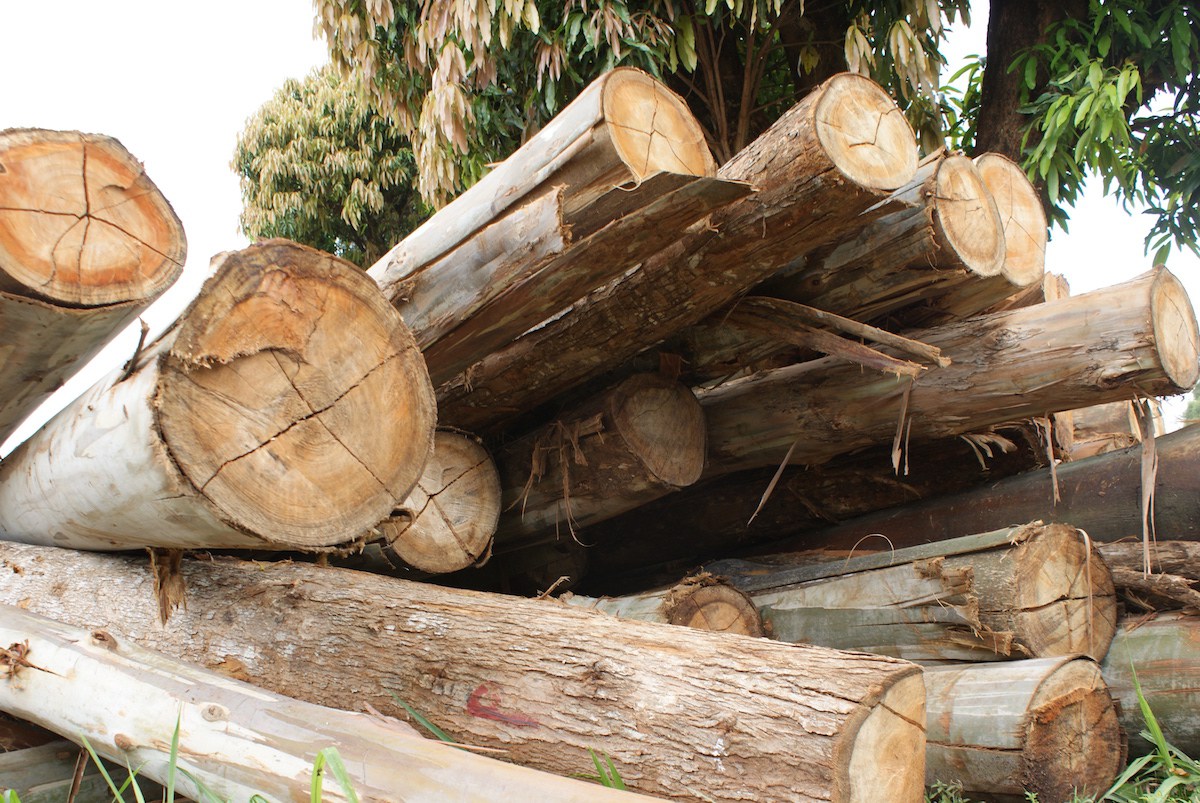
“When I visited KFS and told them I wanted to plant bluegum, they asked where I was to plant them and they advised me on which types are best. My question to them was, ‘is bluegum not bluegum”? And this is when I learned that there are bluegums that can do well in Kitale and perform poorly in Kiambu or Nyadarua,” she said.
She invested about Sh100,000 in seedlings, planting and logistics.
“I bought at Sh20 per tree and then they offered to plant for me at Sh4 per tree. It was also an advantage to get KFS plant for me, because they had to do everything right. I mean the spacing and everything. They also offer advice on how to care for the trees and how to harvest,” she said.
Her trees are now approaching harvest age, and Lucy is expecting to sell around 2,000 bluegum trees from her Ol Kalau farm.
“I am planning to harvest the trees in 2028. I will not fell all of them, I will leave others for them to fully mature and have more timber in terms of volume. In all that I can say I invested around Sh100,000 because of even the logistics,” she said.
In 2010, the KFS estimated that 77 per cent of the country’s tree cover was on private or community land, and 23 per cent was public forestry. Almost half of the country’s forestry was thought to be in private plantations, based on an FAO-funded plantation survey in 1992.
There are no records on what has happened to private forestry volumes since that survey 34 years ago. But donors have almost doubled public forestry investment spending in 2026, supporting the 2025 amendment of the Forestry Act mandating KFS to provide technical support to private foresters, and set up a new academy and regulator.
As more funds to support forestry flow into the public purse, catalysing private sector investments has thus become a primary target.
The amendment did also create a framework for ecosystem payments to better preserve forests through payments to surrounding communities, so that the methodology exists, should any payments ever be introduced.
But no government structured support for carbon credits yet exists, despite being cited frequently by private investors as a considerable, potential incentive.