
Avocado exporter adapts pest control for EU exports
By MaryAnne Musilo
Mary Wambui, an agronomist and avocado farmer in Murang’a, has battled fruit abortion and anthracnose on her Hass avocado trees, which are now 15 to 20 years old. The biggest problem, she said, has been fruit shedding caused by fruit flies.
“I practice mixed farming on an acre of land. Fruit fly has been the main pest that has been giving me challenges. They attack the tree at flowering stage, hence causing the fruit to fall immediately after fruit formation or before maturity,” said Mary.
Fruit flies pierce the fruit skin to lay their eggs, and the wounds allow bacteria to enter. As the eggs hatch, the maggots feed inside the fruit, making it rot and drop before it matures. To keep this in check, Mary uses pheromone traps, which both monitor and reduce the fly population.
“Assembling a Delta Trap with a sticky liner and pheromone lure helps in reducing the fly population and invasion,” she said. The trap is set up in the orchard by hanging it on the tree branches. The lure releases a scent that mimics the smell of the female fly, which attracts the males. When they land on the sticky liner inside the trap, they get stuck and die, breaking the breeding cycle. Farmers must check and replace the liners when they fill up with insects and replace the pheromone lures every four to six weeks to keep them effective.
Mary also uses the traps against another pest that affects export quality, the false codling moth (FCM). “The traps also help control FCM that attacks the fruit at fruiting, leaving a mark on the skin of the fruit, making it unsuitable for export market,” she said. When the moth lays eggs on young fruits, the larvae bore into the pulp, leaving holes and scars that make the fruit unmarketable. By lowering the male moth population, the traps reduce the number of fertile females that go on to damage the fruit.
Related News:
Timau avocado farm deploys used engine oil to kill its biggest pest menace
Avocado farm sees 150% fruit increase shifting to weed and pepper pesticide
Kakuzi offers free maturity testing as avocado export season announced
She combines these traps with chemical sprays when necessary. “Using pesticides like Emmaron and field hygiene also helps in controlling the pests,” said Mary. Emmaron is an insecticide that is sprayed directly on the avocado trees. For it to work effectively, the spray must reach the inner canopy where the pests hide. Timing is important too: it is best applied when monitoring shows pest levels rising, but before heavy infestation, so the crop remains within the low residue levels required for export.
Good orchard hygiene is another line of defence. Mary removes dropped fruits quickly so that maggots in fallen fruit cannot develop into adults and reinfest the orchard. She also prunes regularly to keep her trees open. “Field hygiene, eg pruning and managing the density of the tree canopy for good aeration, can reduce anthracnose, a disease that has given me headache,” she said.
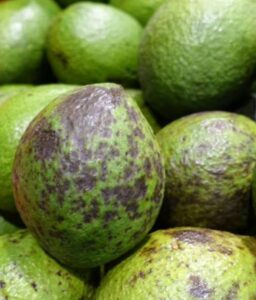
Anthracnose is a fungal infection that shows up as black lesions on leaves and fruits. “Anthracnose mainly characterised by black lesions on the leaves and fruits was quite challenging for me. Maintaining the export quality is a lot. The disease delays the tree growth and production,” she said. The fungus spreads most easily when the orchard is humid and the trees are overcrowded. By pruning to open up the canopy, Mary reduces the moisture that allows the spores to spread. She also removes diseased fruits, leaves, and flowers. “Pruning the affected fruits, leaves and flowers helps in curbing the disease,” she said.
By combining pruning, sanitation, traps, and pesticides, Mary has kept her orchard productive, although her yields vary. In a good year she harvests between 5,000 and 8,000 kilograms of Hass avocados for the export market, she said.
Are you a farmer looking to grow the most profitable crop on your farm, with or without irrigation. Use FarmBizAfrica’s HarvestMAX on https://harvestmax.farmbizapps.com and it will tell you in less than a minute what the highest income-earning crops are for your weather, soil type and this season, based on your seasonal weather forecast. Don’t make weather losses ever again, and more than triple your income.
Get your farming news by email.
Free. Market prices, crop news and farmer opportunities, straight to your inbox.