
Embu farmer earns Sh350,000 a month for bee venom ‘white gold’
By MaryAnne Musilo
Embu Human Resources graduate Mwiti Kitson originally got two bee hives to add sweetness to his organic farming, but instead discovered bee venom farming now earning him up to Sh350,000 a month.
The turning point, said Mwita, was a five-year honey contract with Savannah Honey that came with free training. That started his journey into producing over 50 grammes a month of agriculture’s new, white gold.
“With the honey, I began to make small profits and with support from my family and even small loans, I added more hives, 10 and then another 10, but it was the training where I learned about the bee venom,” he said.
The demand for bee venom has galloped globally on claims it kills cancer cells in breast and prostrate cancer – even before proper research to see it it kills other cells in the body. Its main use, now, is as an ingredient in anti-aging cream, where it rapidly refreshes the skin.
For Mwiti, the discovery that Savannah Honey was paying Sh6,800 a gramme for bee venom got him interested in the extra product beside his honey.
“It’s not that I just farm bee venom, now I do all three, the organic vegetables, honey, and bee venom,” he said.
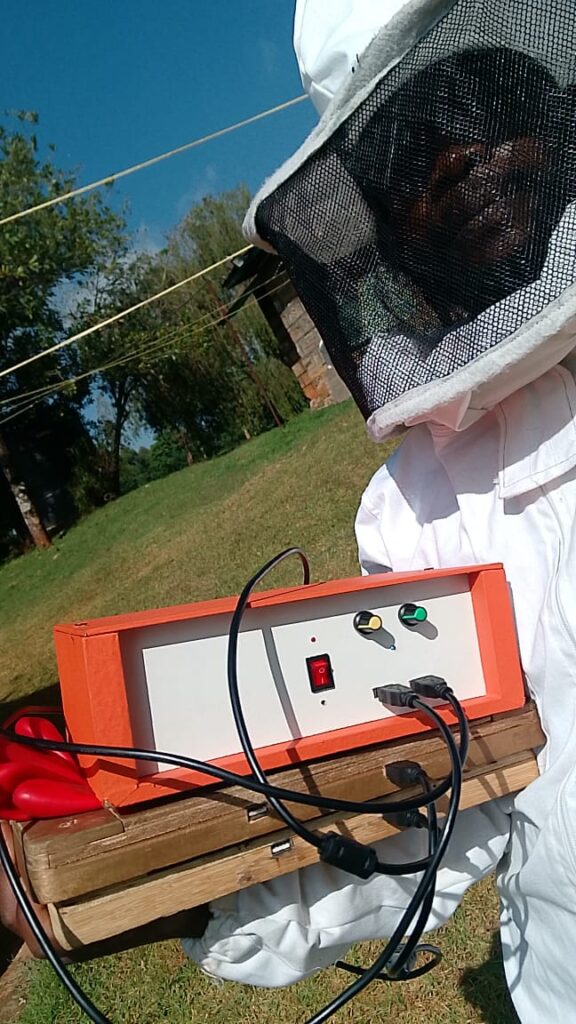
To start producing the venom he bought a collection plate, which Savannah sells for between Sh60,000 and Sh85,000.
‘I have about 50 Langstroth hives now, and the plate fits onto them. You switch the collector plate on and it creates a tiny current, it mustn’t be too high or it harms the bees, but set really low, when the first bad lands on it, it sense the disturbance and releases pheromones that call all the other bees to defend and protect. You get the bee venom from them stinging the plate” he said.

He runs the plate for about 50 minutes. “It’s really important not to distirb the bees so the best times are between 7am and 9am in the morning or in the evening,” said Mwita.
When he switches the plate off, the bees leave, and the venom is left as a white powder. He leaves it for about 5 minutes then collects it, before it has oxidised.
“It’s important you cover your nose when you’re collecting it, as it’s a powder and you could breathe it in, causing harm,” he said.
He scrapes the powder off the plate into a storage jar that’s like a test tube.
Related News:
Kenyan beekeepers target Europe for export of lucrative bee venom
Savannah Honey launches beekeeping drive, contracting 7,000 farmers across Kenya
Farmer extracts millions from bee venom
“Then you dip the closed tube into something cold, preferably rice, to keep it cold and dry.
A good colony can produce 0.5 grammes per hive per collection, which Mwiti does twice a month, earning around Sh7,000 per hive per month, totalling up to Sh350,000 a month.
But demand is still running a long way ahead of supply, pulling many extra farmers into the sector.
“Savannah has been opening bee venom collection centres in most of Kenya’s big towns and is recruiting several thousand more contract farmers,” he said. “And I am also now training farmers on how to farm the venom.”
“For me, I hope the finances are found to complete the research in bee venom, so we could use it as a cancer treatment as well as for anti-aging creams, but it is already good money for the creams.”
For farmers starting, he said, “It’s better to start with at least five hives,” to make the harvesting and the cost of the plate and storage worthwhile.
To contact Savannah Honey directly about bee farming contracts, reach them on 0721 965 337.
Are you a farmer looking to grow the most profitable crop on your farm, with or without irrigation. Use FarmBizAfrica’s HarvestMAX on https://harvestmax.farmbizapps.com and it will tell you in less than a minute what the highest income-earning crops are for your weather, soil type and this season, based on your seasonal weather forecast. Don’t make weather losses ever again, and more than triple your income.
Get your farming news by email.
Free. Market prices, crop news and farmer opportunities, straight to your inbox.