Baringo dairyman earns Sh46,000 more monthly switching to Boma Rhodes grass
4 min read
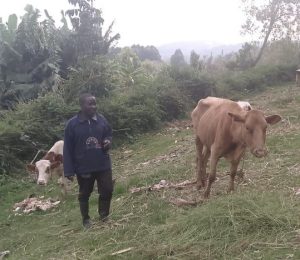
Jackson Keitany, a dairy farmer from Kiplombe in Baringo County is now making Sh19,000 profit a month from milk sales, compared to Sh27,000 loss per month three years ago, due to planting his own Boma Rhodes grass fodder.
Kiplombe, where Keitany has over 40 acres of land under dairy production, is a semi-arid area where drought has grown worse due to climate change. However, he has been able to increase his milk production by changing the way he feeds his dairy cattle, following training by an NGO and the Ministry of Livestock Development.
In May 2017, Keitany sold 1081 litres of milk, earning Sh58,416 from an average selling price of Sh54 a litre. But in the same month, due to low rains, Keitany ran out of hay, which was his main source of roughage for his cows and was forced to buy hay from the market.
Keitany first bought 59 bales costing him Sh10 per litre of milk produced. When this ran out, he bought an additional 30 bales costing him another Sh12.56 a litre. He finally purchased the third batch of 40 bales costing Sh14.77 per litre.
In the same month he used 465 kilos of concentrate, costing him Sh19.06 per litre of milk produced. Adding labour costs at Sh10 per litre, health care cost at Sh2, and other costs, Keitany had a total expenditure of Sh86,400, meaning he spent Sh80.37 producing one litre of milk that he sold for Sh54. This means he made a loss of Sh27,984 or Sh26 for every liter he produced.
However, things started turning around for the 73-year-old former government employee when he met officers from the Kenya Market-led Dairy Programme (KMDP) and the Ministry of Agriculture who started training farmers in the area in good dairy production practices.
KMDP consultants and Kiplombe’s extension officer visited Keitany’s farm and noticed his progress and willingness to learn and he was selected as one of 20 ‘demonstration farmers’ from the Kiplombe Dairy Society.

Today, he has made much progress, abd never buys fodder, but grows his own. At the onset of the rainy season, he buys 14 bags of CAN fertilizer that he applies on his one acre of Bhoma rhodes that he established last year.
The grass turns around in less than 20 days from the day of fertilizer application meaning he doesn’t need to buy roughage. He uses 231 bales, 102 bales more than the hay he used to consume.
The hay produced from his own farm costs him Sh8.46 per litre of milk produced. He has since reduced the quantity of concentrate that he feeds to the cattle by 15 kilos as well, reducing his cost per litre from Sh19 to Sh10.
RELATED CONTENT:Farmers cash in on emerging hay and cattle delivery sub-sector
The milk price always drops during the rainy seasons. However, the total production from Keitany’s farm has increased to 1583 litres, resulting in total revenues of Sh73,831 and a profit of Sh12.06 for every litre sold. Last month, Keitany made a profit of Sh19,117.
He now says feeding signifies a huge cost to a dairy farm. “Reducing costs associated with feeds plays a big role in determining whether a farm makes a profit or loss.”

In addition, he has noted an increase in milk production when he started feeding his six milking cows lucerne alongside maize silage and Rhodes hay, with them now producing a total of over 1600 litres, which is an increase of 45 per cent compared to previous years.
Keitany’s age prevents him from doing heavy labor, but he still thinks about the future of his dairy farm. He would like to increase the production of the current ten milking cows from an average of 60 litres of milk per day up to 200 litres of milk per day year-round.
RELATED CONTENT:Organisation equipping small-scale arid farmers with skills & tools to store fodder
In terms of feeding, Keitany feels he has improved over the last two to three years, but also knows he can improve even more. He wants to replace the sorghum with Boma Rhodes grass and intends to check the nutritional value of lucerne and the other feed crops. He wants to improve the cow shed and the zerograzing unit and plans to irrigate his farm with water from the dam, so he will no longer depend on rains.
Are you a farmer looking to grow the most profitable crop on your farm, with or without irrigation. Use FarmBizAfrica’s HarvestMAX on https://harvestmax.farmbizapps.com and it will tell you in less than a minute what the highest income-earning crops are for your weather, soil type and this season, based on your seasonal weather forecast. Don’t make weather losses ever again, and more than triple your income.