
Black Mamba chilli sauce builds smallholder-supplied exports globally
By Antynet Ford
Claudia Castellanos is a multinational who has built a business exporting chilli sauce from Eswatini to eight countries globally, in a business model now supporting 90 smallholders, and rising.
The success of her business, Black Mamba, of which she is the founder and CEO has been driven by a focus on training, transparency and end-to-end benefits, with the starting point being an adequate living income, said Claudia. in an exclusive interview with FarmBizAfrica.
“The living wage of Eswatini is still very low at Rands 1,500 a month. It’s really very difficult to live on Rands 1,500 really. Knowing that they all depend on selling their products to Black Mamba, we pay an average Rands 1,800, depending on the quality supplied,” she said.
But to make that work as a business requires extra guidance to farmers.
“One key thing that we do is be transparent in our contract with the farmers and we renew it every year. The contracts are done in English and Siswati to ensure there is clarity. They are also specific on how the crops need to be grown, what crops are going to be taken or rejected. They have photos of what is good and bad and when the harvest needs to be done, and the information remains the same throughout the year without changing.”
“The other thing is communication. We clearly communicate to them, for example, on the pickup dates and time, because they do not have smart phones most of them. So, if it’s Thursday at 2:30pm, we ensure that we are there by that time, whether rain or shine, because when you change that some of the farmers may not be aware and you might lose track.”
“So the things are transparency, commitment and clear communication.”
“The prices are always higher than the market prices because the production is organic. The contracts also stipulate the amount of product a farmer is expected to supply, for example, 300 kilograms over a whole year. Sometimes they may supply less because they were unable to meet the set standard. Other times, they produce more, but we look into it to align with what the contract says. Farmers always share their side on how they’ve been affected by the climate, the price of seeds, and many more things, and we always listen to it and negotiate,” said Claudia.

Claudia, who is originally from Colombia, moved to Eswatini from Italy, and quickly realised the roadblock for the rural smallholders was market access.
There were no reliable buyers, no guaranteed price, and no incentive to grow beyond household consumption. Supermarkets preferred importing produce from South Africa, not because Eswatini could not grow food, but because local supply was inconsistent and unreliable.
“People used not to grow anything in their land – even now, statistics show that 90 per cent of food in Eswatini is imported. This includes foods that can be grown in the country. For those who did farm, it was mostly for survival.”
Yet 72 per cent of the country’s population live in rural areas.
“There seemed to be a disconnect between the farmers and the market because organisations that are supposed to connect farmers and the market did not.”
Together with her partner, she began looking at food processing as an entry point.
“I was working as a volunteer in the rural area of Eswatini, which made me see how we could support women into business and bettering their lives. At the start, these were six farmers who were just doing subsistence farming where they were growing two or three crops just for their families. Rearing chicken, growing maize, vegetables, those with a higher capability had cows and that’s it.”
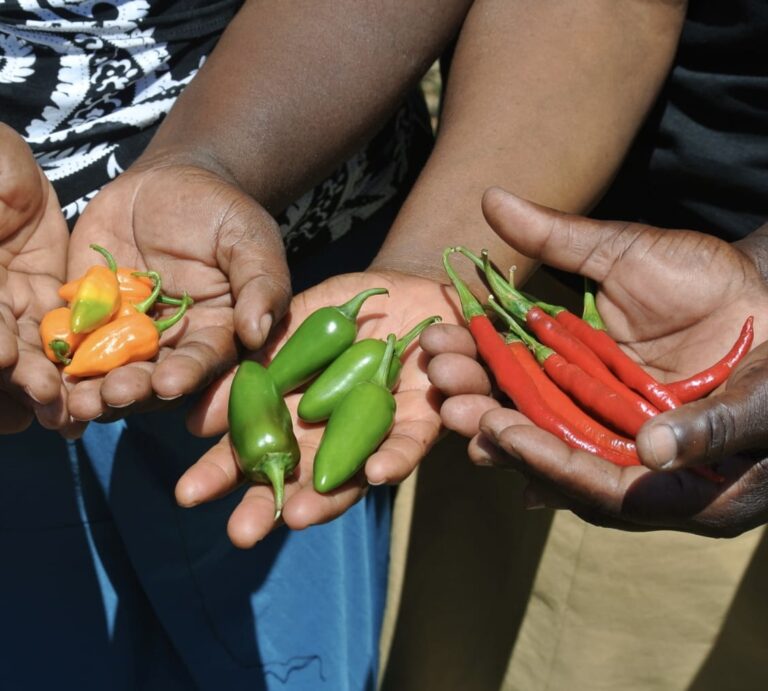
“We decided to venture into a food model because we loved good food. My husband was crazy about chillies, and I thought that would be a good start, because they grow well in Eswatini and they would give space to work on something great.”
They began by making the chilli sauce at home.
“From the beginning, we have always had the smallholder farmers at heart, even though people around us did not understand why we needed the farmers to grow their products organically. We prefer working with a single farmer until they say this is the maximum I can give before we add more farmers into the value chain, because we want to make a difference.”
“If we were to go for the commercial farmers, we would have lost the essence of why Black Mamba was created. We created it to help the real communities to change their perspective on how agriculture needs to be done.”
But smallholder sourcing has been challenging.
“We quickly realised how difficult it is to work with the smallholder farmer because you have to collect a KG from one farmer, half from the other, two from another one.”
Partnerships became essential, so they first partnered with World Vision, which helped identify farmers in rural communities, and later with Guba, an organisation specialising in organic and climate-resilient farming.
“Guba trains farmers to grow climate resistant crops that do not have external inputs like fertiliser that are not organic.”
Through this partnership, the supply chain expanded from six women farmers to forty-five, all trained in organic production. When Guba later stepped back from logistics in 2025, Black Mamba adapted again, partnering with Witad and two women-led cooperatives, which has seen them now grow to the current 90 smallholders.
The impact for those farmers, said Claudia, includes stability, dignity, and resilience, with farming practices, such as mulching, water harvesting during the rains, and soil care, helping farmers cope better with climate stress.
“Our farmers are well equipped in terms of climate change because of the organic farming, which helps them harvest water well (rain water) do the mulching etc. it creates resiliency with the crops.”
READ ALSO:
Murang’a farmer launches 20,000 chilli seedling nursery after fakes lose her Sh197k
Double chilli pinching more than doubles yields
Exporter forced out of chillies by FCM pest retries with netting
Climate shocks are nonetheless common and sometimes devastating in Eswatini. “In the recent heavy rains, everything was flooded over…all the crops died,” said Claudia.
At such times, Black Mamba is forced to supplement supply with commercial farmers to protect the business, but continues investing in its smallhold suppliers’ readiness through smart climate farming, greenhouses, and protective infrastructure.
“The big dilemma is being sustainable, because we are not an NGO, but a business. If we are not sustainable then no one can be part of the value chain. I am trying to make agriculture cool again and ensure that the young people get onto it as Africans can sustain themselves with agriculture, as they have the potential,” she said.
“The success of farmers is ensuring they are completely sustainable and they are able to afford every expense they need and live a quality life by supplying to Black Mamba.”
With the company’s export brand now supplying eight countries including the US, the UK, UAE, Germany, Norway, Taiwan and South Africa, Claudia is emphatic: sustainable food processing in Africa rests on creating “farmers’ value, and a food system that finally works for the people who feed it”.
Are you a farmer looking to grow the most profitable crop on your farm, with or without irrigation. Use FarmBizAfrica’s HarvestMAX on https://harvestmax.farmbizapps.com and it will tell you in less than a minute what the highest income-earning crops are for your weather, soil type and this season, based on your seasonal weather forecast. Don’t make weather losses ever again, and more than triple your income.
Get your farming news by email.
Free. Market prices, crop news and farmer opportunities, straight to your inbox.