Farmer works on solution for Coast’s plant-killing saline soils
7 min read
By MaryAnne Musilo
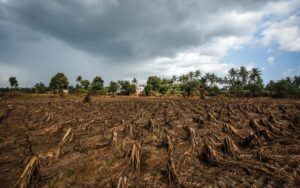
Kwale farmer Isaac Lihanda is working on farm plans using neem trees to reverse salinity, which has been destroying up to 90 per cent of crops in areas such as Malindi and Kwale.
As sea levels rise by almost 4mm a year along Kenya’s coast, salty sea water has moved further inland and reached boreholes. Scientists report that irrigation from these holes cuts vegetable growth by as much as 89 per cent.
The crops affected include amaranth, which is now widely grown at the coast, but highly sensitive to too much salt.
In Kwale, the spread of seawater into boreholes from 1990 to 2012 tripled salt levels, leaving many farmers unable to grow crops at all.
Now much of Kilifi, Kwale, Tana River, Lamu and Mombasa are saline, with surveys classifying Malindi and Kwale as moderately saline and parts of Malindi as severely saline.
Salinity has also affected the Hola Irrigation Scheme in Tana River, seeing some sections of the scheme abandoned as yields collapsed because of too much salt.
For Isaac, the worsening salinity has destroyed crops in his own fields, seeing him work to refine a solution.. “I’ve farmed my entire life, but I never liked using fertilisers and chemicals. When I studied organic farming in India this past February, I learned many natural methods,” he said.
He is now experimenting with different ways of using the neem tree, known locally as miarubaini. “We take leaves and branches of the trees. We can not cut the whole tree because we care for the trees. We then burn them and get the ash, which we later mix with the soil. We then put manure for example the cow dung, then afterwards we plant,” he said.
Scientists have found that neem ash can actually increase salts in soil. But Isaac is also using the leaves to make foliars and liquid fertilisers.
Neem seed, cake, and residues have all been found to successfully reduce soil salt levels, with trials that added neem powder to soils finding its salinity fell by as much as 36 per cent.
Isaac uses neem leaves once his plants have germinated. “After germination, we take the neem leaves, crush them, mix with water, after some few minutes, we sieve and spray on the plants.”
As well as helping with salinity, “this also keeps away pests,” he said.
Neem can protects crops from common pests such as aphids, whiteflies and caterpillars, that can otherwise destroy as much as 80 per cent of a crop.
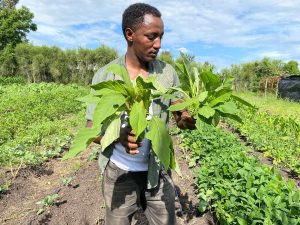
Following his neem treatments, Isaac reports: “Yields are excellent. Inputs are cheaper, no chemicals are used, and pest damage is minimal,” said Isaac, who now grows amaranth, tomatoes, red onions, cassava, okra, collards, brinjals and black nightshade using only non-hybrid seeds.
He has also now trained some 400 other farmers in how to control the salt in soils, as a volunteer.
“Many farmers in Kwale had stopped farming due to three years of drought. Now that the rains are back, we’re rebuilding and empowering them is my aim,” he said. By MaryAnne Musilo
Kwale farmer Isaac Lihanda is working on farm plans using neem trees to reverse salinity, which has been destroying up to 90 per cent of crops in areas such as Malindi and Kwale.
As sea levels rise by almost 4mm a year along Kenya’s coast, salty sea water has moved further inland and reached boreholes. Scientists report that irrigation from these holes cuts vegetable growth by as much as 89 per cent.
The crops affected include amaranth, which is now widely grown at the coast, but highly sensitive to too much salt.
In Kwale, the spread of seawater into boreholes from 1990 to 2012 tripled salt levels, leaving many farmers unable to grow crops at all.
Now much of Kilifi, Kwale, Tana River, Lamu and Mombasa are saline, with surveys classifying Malindi and Kwale as moderately saline and parts of Malindi as severely saline.
Salinity has also affected the Hola Irrigation Scheme in Tana River, seeing some sections of the scheme abandoned as yields collapsed because of too much salt.
For Isaac, the worsening salinity has destroyed crops in his own fields, seeing him work to refine a solution.. “I’ve farmed my entire life, but I never liked using fertilisers and chemicals. When I studied organic farming in India this past February, I learned many natural methods,” he said.
He is now experimenting with different ways of using the neem tree, known locally as miarubaini. “We take leaves and branches of the trees. We can not cut the whole tree because we care for the trees. We then burn them and get the ash, which we later mix with the soil. We then put manure for example the cow dung, then afterwards we plant,” he said.
Scientists have found that neem ash can actually increase salts in soil. But Isaac is also using the leaves to make foliars and liquid fertilisers.
Neem seed, cake, and residues have all been found to successfully reduce soil salt levels, with trials that added neem powder to soils finding its salinity fell by as much as 36 per cent.
Isaac uses neem leaves once his plants have germinated. “After germination, we take the neem leaves, crush them, mix with water, after some few minutes, we sieve and spray on the plants.”
As well as helping with salinity, “this also keeps away pests,” he said.
Neem can protects crops from common pests such as aphids, whiteflies and caterpillars, that can otherwise destroy as much as 80 per cent of a crop.
Following his neem treatments, Isaac reports: “Yields are excellent. Inputs are cheaper, no chemicals are used, and pest damage is minimal,” said Isaac, who now grows amaranth, tomatoes, red onions, cassava, okra, collards, brinjals and black nightshade using only non-hybrid seeds.
He has also now trained some 400 other farmers in how to control the salt in soils, as a volunteer.
“Many farmers in Kwale had stopped farming due to three years of drought. Now that the rains are back, we’re rebuilding and empowering them is my aim,” he said. By MaryAnne Musilo
Kwale farmer Isaac Lihanda is working on farm plans using neem trees to reverse salinity, which has been destroying up to 90 per cent of crops in areas such as Malindi and Kwale.
As sea levels rise by almost 4mm a year along Kenya’s coast, salty sea water has moved further inland and reached boreholes. Scientists report that irrigation from these holes cuts vegetable growth by as much as 89 per cent.
The crops affected include amaranth, which is now widely grown at the coast, but highly sensitive to too much salt.
In Kwale, the spread of seawater into boreholes from 1990 to 2012 tripled salt levels, leaving many farmers unable to grow crops at all.
Now much of Kilifi, Kwale, Tana River, Lamu and Mombasa are saline, with surveys classifying Malindi and Kwale as moderately saline and parts of Malindi as severely saline.
Salinity has also affected the Hola Irrigation Scheme in Tana River, seeing some sections of the scheme abandoned as yields collapsed because of too much salt.
Related News:
Organic farmers look to neem’s powers to ‘cure everything’
Nakuru Farmers Reduce Pests 40% With Neem Leaves
Coastal Farmers Find Empowerment Growing Neem Trees
For Isaac, the worsening salinity has destroyed crops in his own fields, seeing him work to refine a solution.. “I’ve farmed my entire life, but I never liked using fertilisers and chemicals. When I studied organic farming in India this past February, I learned many natural methods,” he said.
He is now experimenting with different ways of using the neem tree, known locally as miarubaini. “We take leaves and branches of the trees. We can not cut the whole tree because we care for the trees. We then burn them and get the ash, which we later mix with the soil. We then put manure for example the cow dung, then afterwards we plant,” he said.
Scientists have found that neem ash can actually increase salts in soil. But Isaac is also using the leaves to make foliars and liquid fertilisers.
Neem seed, cake, and residues have all been found to successfully reduce soil salt levels, with trials that added neem powder to soils finding its salinity fell by as much as 36 per cent.
Isaac uses neem leaves once his plants have germinated. “After germination, we take the neem leaves, crush them, mix with water, after some few minutes, we sieve and spray on the plants.”
As well as helping with salinity, “this also keeps away pests,” he said.
Neem can protects crops from common pests such as aphids, whiteflies and caterpillars, that can otherwise destroy as much as 80 per cent of a crop.
Following his neem treatments, Isaac reports: “Yields are excellent. Inputs are cheaper, no chemicals are used, and pest damage is minimal,” said Isaac, who now grows amaranth, tomatoes, red onions, cassava, okra, collards, brinjals and black nightshade using only non-hybrid seeds.
He has also now trained some 400 other farmers in how to control the salt in soils, as a volunteer.
“Many farmers in Kwale had stopped farming due to three years of drought. Now that the rains are back, we’re rebuilding and empowering them is my aim,” he said.
Are you a farmer looking to grow the most profitable crop on your farm, with or without irrigation. Use FarmBizAfrica’s HarvestMAX on https://harvestmax.farmbizapps.com and it will tell you in less than a minute what the highest income-earning crops are for your weather, soil type and this season, based on your seasonal weather forecast. Don’t make weather losses ever again, and more than triple your income.