Coffee production sinks on climate bumps and pesticide bans
2 min read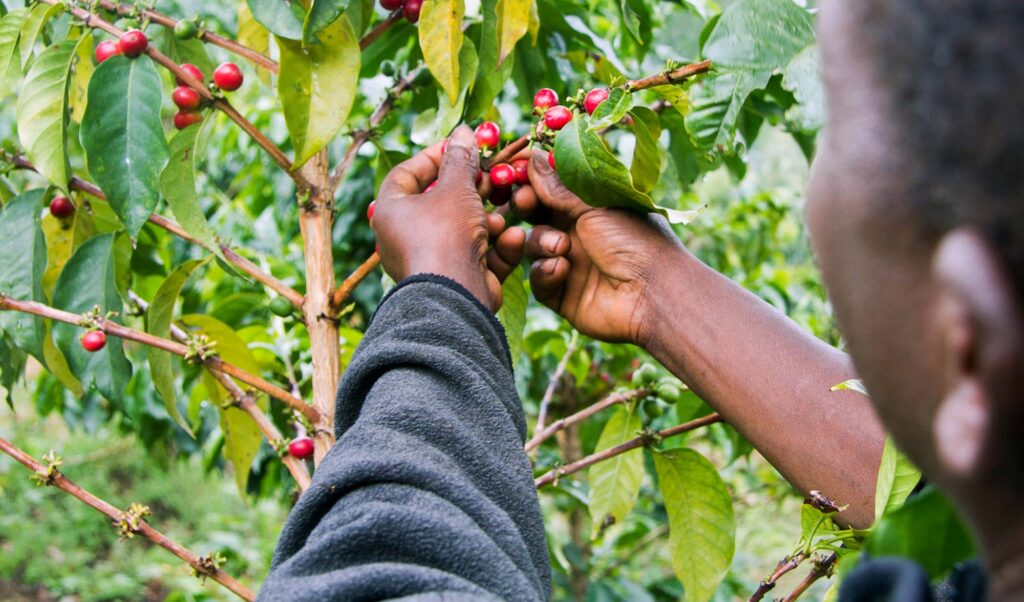
The hybrid variety known as Batian produces many primary branches hence higher yields, and has performed well in withstanding perennial coffee diseases like Berry disease, Leaf rust and Bacterial Blight.
By James Odhiambo
In the hilly landscapes of Kiambu County, Francis Nginge, a Kikuyu resident and seasoned coffee farmer, faces mounting uncertainty in an industry once considered the backbone of Kenya’s economy. Nginge’s troubles began after the Pest Control Products Board banned Chlorpyrifos-based pesticides in July 2021—products he relied on heavily to control Coffee Berry Borer (CBB) as the most destructive pest in coffee farming.
“Before the ban, I was using Agropyrifos 48EC from Bell Industries Kenya, which was extremely effective in clearing off the Coffee Berry Borer from my farm,” he said. Following the regulatory shift, Nginge moved to a bipesticide Mazao ACHIEVE, produced by Real IPM (Kenya) Limited, spraying it immediately after rains,, when coffee berries are formed, and as they are approaching maturity.
He also pruned much more intensively and removed the diseased blackened berries and burnt them. But the results were only partially successful. “These interventions require a lot more labour, and my yields have dropped drastically – from 10 tonnes to just 5 tonnes,” he said.
His experience has been mirrored by thousands of coffee farmers , with the Agricultural Food Authority reporting that nationally produced clean coffee was already declining during the 2022/23 season, down 6.2% to 48,649 tonnes, down from 51,853 tonnes in 2021/22. AFA has reported in its newly released 2024 Year Book of Statistics that this was due to weather conditions that accelerated diseases, notably Coffee Berry Disease (CBD).
At the same time, Coffee Berry Borer, the world’s most destructive coffee pest, has continued to expand in the country. Kenyan coffee was previously largrly free of coffee berry borer, since it is grown at altitudes that were too high for the pest. But climate change has seen the borer’s breeding accelerate and a climb in the altitudes of its infestations.that scientists estimate is climbing 200 metres a year
Related News:
Coffee farmers halve berry borer infestations by destroying fallen cherries
Coffee farmers staring at losses berry disease destroys crop in Mt. Kenya region
Chaos brews in Kenya’s coffee sector as farmers await sip of vaunted reforms
This is generating increasingly savage losses of cherries, while the government has also chosen to ban the key pesticide for CBD and CBB.
According to the AFA the worst affected areas in 2022/2023 were those “in the central region of the country”.
Farmers, such as Francis in Kiambu, are reporting that the declines were even greater in 2023/24.
Are you a farmer looking to grow the most profitable crop on your farm, with or without irrigation. Use FarmBizAfrica’s HarvestMAX on https://harvestmax.farmbizapps.com and it will tell you in less than a minute what the highest income-earning crops are for your weather, soil type and this season, based on your seasonal weather forecast. Don’t make weather losses ever again, and more than triple your income.