Frontier science: a brush to end fowlpox, brutal losses in rural chickens
4 min read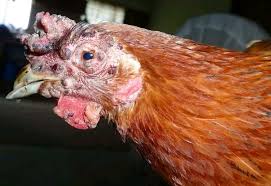
By Consolata Thuita and Jenny Luesby
Scientists have found a potential solution to a double disease curse knocking out up to two-thirds of rural poultry yields across Africa.
Diseases kill around half of all poultry in Africa and 75 per cent of chicks under 8 weeks, with one study in western Kenya finding 60 per cent of chicken losses were due to deaths on diseases, versus 40 per cent on sales or home consumption. The same diseases are also reducing growth and laying by poultry that survive, with policy makers identifying Newcastle Disease and Fowlpox as together placing a dead hand on smallholders’s poultry production.
Of the two, Newcastle disease is the more dramatic, found in 50 per cent of chicken in Kenya’s cool, wet zones, and 93.8 per cent of village indigenous chickens in dry zones and wiping out sometimes entire flocks, alongside persistent reductions in growth and laying.
Fowlpox is less well studied and less deadly, but still seriously harmful, making chickens weak, reducing growth and laying, and also causing deaths as chicken struggle to eat, drink or breathe due to sores in the corners of their mouth and on their tongues, throats and food pipe. A four-year analysis of vet clinic records in Nigeria found that 33.4 per cent of the 3,700 chicken mortalities reported were due to fowlpox.
But the challenge for rural farmers is that while both diseases can be prevented by vaccination, few indigenous chicken are ever vaccinated.
This is often ascribed to an inadequate number of the vets and vet techs needed to inject them, but the veterinary capacity in Kenya is more than enough.
The Kenya Veterinary Paraprofessionals Association, alone, reports a membership of some 15,000 veterinary paraprofessionals.
Vaccinating all of the country’s 115m livestock across cows, pigs, goat, sheep, and poultry would require each vet tech to deliver 21 injections per working day (allowing for holidays), compared with the 50-100 a day delivered per professional during vaccination campaigns. That puts in place ample capacity.
The bigger problem lies in how vaccinations are organised, which is normally as episodic campaigns that send visiting professionals out to inject. These vaccinators must then find, access, or receive livestock, including poultry. Yet studies show many rural farmers are unaware of the impact of diseases such as fowlpox or that vaccinations can prevent it.
Thus, vaccinators are sent, but farmers often don’t know they have arrived, and also have no particular (known) reason to care or engage.
The consequence of this dislocation is massive for Kenya, with indigenous chickens kept by about 90 per cent of rural households, producing 55 per cent of Kenya’s poultry meat and 47 per cent of eggs nationally, in 2010.
Government statistics suggest that has since fallen, to around 60 per cent of rural households now relying on chickens for food and income. But with vaccinations reaching very few of them, researchers have been seeking ways to protect them in ways that don’t require a professional injection.
For Newcastle Disease, eye drops can work and are being increasingly administered by community workers. But what if, asked one team of researchers, we could find a way for locals to protect poultry from fowlpox too, without injecting, and protect chickens from both diseases together, to deliver a double shield.
By equipping locals to administer, the need to find people (or their chicken) on any specific day, or get them to come to a vaccination site, with often up to 30 chicken, is gone. More extended, locally connected and flexible protection becomes possible. It also becomes more possible to vaccinate new chicks over time.
Which has made the study carried out in Tanzania and Nepal treating over 1100 chicken on hundreds of farms into FarmBizAfrica’s definition breakthrough science. The study found that if the chicken’s thigh was plucked of feathers, the culture for the vaccine could be brushed up into the feather holes, delivering 94-96 per cent reaction – where the reaction shows the body has absorbed the vaccine and has begun its move towards immunity..
The scientists ran tests just brushing in the fowlpos remedy and tests where they combined that with eye drops for Newcastle Disease and found the remedies worked both alone and together.
The team from the Global Alliance for Livestock Veterinary Medicines worked with university researchers from the UK, Tanzania and Nepal, and published its findings in the journal of Tropical Animal Health and Production in 2022.
Considering the scale of losses to small holders due to these diseases and the constraints on rural campaigns of injections, we are naming the team as the first in our new series celebrating frontier science in African agriculture, and will take it upon ourselves to follow and report all moves to roll out their solution in practice.
Thank you, GalvMed, for this research and its findings.