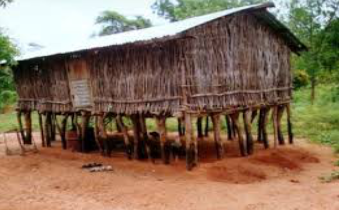
Farmers in the deluge prone Bunyala area of Budalangi who have traditionally lost their harvest due to incessant floods are now assured of safety of their harvests thanks to community granaries that are built on dry areas. The granaries, built through pooling together of resources by local farmers, ensure that anytime farmers harvest they place the surplus in the granaries which they can then get anytime they want for home consumption and for sale.
Richard Uzero a maize farmer in the area and one of the first farmers to embrace the communal granary concept knows just how important it means to him and his family of five. Since early 90’s he has been losing about 60 percent of his surplus harvest to floods. “I have a small granary in my compound. I harvest around five to six bags of maize every harvest. I lose about three of the bags to the floods because by the time I preserve them for a bigger market price the floods have already hit,” he said.
Related News: Low cost cooler helps farmers preserve produce
The community granary built on higher dry area which is not reached by the floods has over 60 farmers and stocks different produce including millet, maize, beans and groundnuts. The granary has a clerk who keeps records of what comes in and out.
Once a farmer brings the produce, he is assigned a specific membership number and card which lists how many bags or kilos have been brought and the date. The farmer can walk in and out any time to remove his produce but must produce his membership number and card. “This ensures that each there is a clean sheet that monitors what comes in and out. Each farmer is allocated a space in the granary to avoid confusion. The space is clearly marked with the member’s name and number,” said Ethan Njunge the chief clerk at the granary.
Members have monthly contributions of Sh250 which goes into the maintenance of the granary and the payment of the clerk. The granary also hosts produce from farmers who are non members but who are charged Sh500 per month to be allocated space. “Already we have 12 non members who we are housing,” said Victoria Auma the secretary of the organization.
Related News: Device that converts any space into a cold room to preserve fresh produce invented
Related News: Farmers cut mango losses by a third with home-made brick coolers
A study conducted by Farm Bulb International, a not for profit organization working with smallholder farmers across Africa found out that smallholder farmers who had invested in the community granaries had managed to invest upto 40 percent of their yields. “This is not just through saving the produce from floods but is allowing them to pick higher market prices at a later date when demand is high.
That has been one of the biggest income generators for households around here. One farmer managed to make Ssh10,000 extra than he would have if he didn’t invest in the granaries,”said Maria Koba a programme officer with Farm Bulb International.