
Sweet potato vines and roots silage offers livestock more proteins
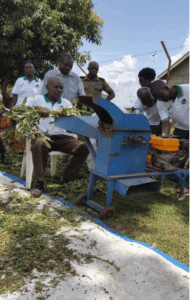
Livestock farmers can boost the Napier grass protein content by including sweet potato vines as well as storage roots in making ‘super’ silage.
The commonest Napier grass varieties have a crude protein content of between 7 per cent and 8.5 per cent.
In making use of the vines and non-commercially usable storage roots after harvesting, the materials, which are discarded after harvest, can be chopped and mixed with Napier grass for use after three months or more.
Silage of sweet potato vine and roots offer livestock crude proteins of up to 14.75 per cent. This is significantly higher than common Napier grass varieties.
Researchers Sammy Agili-International Potato Centre- and Charles Gachuiri-University of Nairobi- said the best combination of the vines and storage roots should be in the ration of 3:1 respectively.
A combination of the vines with Napier grass in the ratio of 5:3 respectively gave 9.7 per cent crude protein while and a digestibility of 80 per cent of dry matter.
Milk, among other nutrients is a core component of milk.
RELATED CONTENT: How to make sheet potato vines silage for feeding pigs
RELATED CONTENT: Farmers make silage from sweet potato vines
The silage has a digestibility of 82 per cent.
“Well-made sweet potato silage is a wholesome and nutritious feed for all classes of cattle, goats and pigs. The silage is prepared by fermenting vines and storage roots, which are stored in absence of air,” the two researchers said in a published finding.
In mixing the three, the ratio of Napier grass to vines and storage roots have to be 5:3:2.
However, during the ensiling period, the succulent vines and roots can present a challenge because of their high moisture content, which can cause rotting.
The duo said farmers using the silage boost milk and meat production by more than 10 per cent. For small-scale farmers, the ensiling can be done using 17litre buckets, which can be consumed once.
This saves the rest from spoilage after opening.
This is a perfect solution for farmers, who discard the vines and the storage roots and peels after harvesting.
Are you a farmer looking to grow the most profitable crop on your farm, with or without irrigation. Use FarmBizAfrica’s HarvestMAX on https://harvestmax.farmbizapps.com and it will tell you in less than a minute what the highest income-earning crops are for your weather, soil type and this season, based on your seasonal weather forecast. Don’t make weather losses ever again, and more than triple your income.
Get your farming news by email.
Free. Market prices, crop news and farmer opportunities, straight to your inbox.